
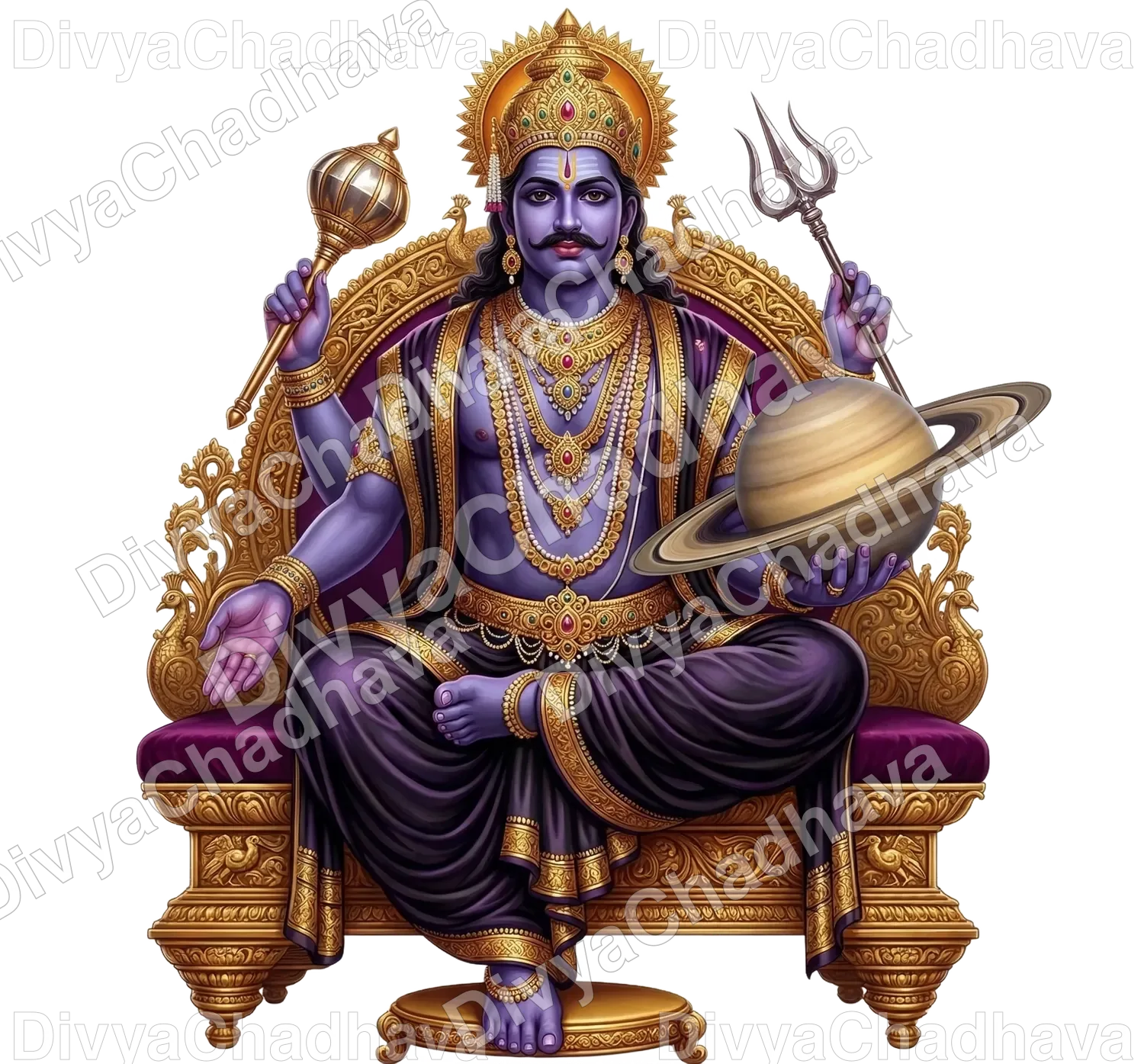
 ॐ शं शनैश्चराय नमः
Shani Dev is the son of Surya, worshipped as the impartial god of karma and justice who rewards righteous action and disciplines wrongdoing without favoritism.
Shani Dev, also known as Shanaishchara or Saturn in Vedic astrology, is the son of Surya, the Sun God, and his wife Chhaya (or in some accounts, Sangya's shadow-form). He is one of the Navagrahas, the nine celestial deities that govern human destiny according to Jyotish, and he holds a unique and often misunderstood position among them. Shani is not a deity of malice or cruelty, as popular fear sometimes suggests, but the strict, impartial dispenser of karmic justice, rewarding righteous deeds and disciplining wrongdoing regardless of a person's status, wealth, or power.
Shani is depicted with a dark complexion, dressed in black or blue garments, seated on a crow, buffalo, or vulture (his vahanas), holding a bow, arrow, sword, and trident. His dark color represents the deep, often uncomfortable truths of karma that must eventually be faced, and his slow-moving nature (he takes approximately two and a half years to transit each zodiac sign, and about thirty years to complete one full cycle of the zodiac) reflects that karmic lessons and justice unfold gradually, not instantly.
Origin of Shani Dev
Shani's birth story explains his stern nature. His mother Chhaya, while pregnant with him, undertook severe penance and fasting in devotion to Lord Shiva, often neglecting food and sunlight during her tapasya. As a result, Shani was born with a dark complexion and, according to some accounts, was initially disregarded or treated coldly by his father Surya, who could not accept a son so different in appearance from his own radiant form. This early experience of rejection is said to have shaped Shani into a deity deeply attuned to injustice, unfairness, and the pain of being judged unfairly, which is why, in turn, he became the staunch upholder of impartial justice, refusing to show favoritism to anyone, be it a king or a commoner, a deva or a mortal.
Another well-known legend tells of Shani's intense devotion to Lord Shiva from childhood, through which he earned the boon of being the dispenser of justice among the Navagrahas. There is also a popular story connecting Shani to Hanuman, in which Shani, after being trapped and humbled during an encounter with Hanuman Ji (in some versions after trying to afflict him or being freed by him from Ravana's captivity), promised never to trouble true devotees of Hanuman, which is why devotees experiencing Shani's difficult periods are often advised to worship Hanuman for relief.
Understanding Sade Sati and Dhaiya
Shani's most well-known astrological influence is Sade Sati, a seven-and-a-half-year period that occurs when Shani transits through the 12th, 1st, and 2nd houses from a person's natal Moon sign, occurring roughly once every 30 years in a person's life. This period is popularly feared because it often brings challenges, delays, restructuring, and tests of patience, but it is important to understand that Sade Sati is not a curse. It is a period of karmic accounting and necessary transformation, during which unresolved patterns, unhealthy habits, and karmic debts are brought to the surface to be resolved, often making a person more disciplined, mature, humble, and spiritually grounded by its end.
Dhaiya, or Shani's two-and-a-half-year transit through the 4th or 8th house from the Moon sign, is a milder version of similar karmic testing. Both periods are meant to be approached with patience, self-discipline, honesty, service to others, and devotion, not fear, since Shani rewards those who conduct themselves with integrity even during hardship.
Significance of Shani Dev
Shani represents the universal law that every action has a consequence, and that true justice does not discriminate. He is often called 'Nyaydhish' or the judge of karma, teaching that hard work, honesty, patience, and service to the poor and marginalized bring lasting rewards, while shortcuts, dishonesty, arrogance, and mistreatment of others invite karmic correction. Rather than being feared as a punisher, Shani is best understood as a strict but ultimately fair teacher who helps souls mature and grow through necessary, sometimes uncomfortable, life lessons.
Famous Shani Temples
Shani Shingnapur in Maharashtra is the most famous Shani temple in India, uniquely known for having no doors on any home in the village, reflecting deep faith in Shani Dev's protection against theft and wrongdoing. Kokilavan Dham near Mathura, Shani Dev Temple in Ujjain, and the Navagraha Temple in Guwahati are also significant. Many Shani temples feature an open-sky shrine, as Shani is traditionally not confined within an enclosed sanctum.
How Devotees Worship Shani Dev
Saturdays are dedicated to Shani Dev, and Shani Jayanti along with Shani Amavasya are especially important days for his worship. Devotees offer mustard oil, black sesame seeds, black cloth, and iron items, and chant the Shani Chalisa and the mantra 'Om Sham Shanaishcharaya Namah' for relief from hardship and karmic burden. Feeding the poor, donating black items on Saturdays, respecting laborers and the underprivileged, and maintaining honesty in one's dealings are considered the most powerful ways to please Shani Dev. Worship of Hanuman is also widely recommended alongside Shani worship for added protection and relief during difficult planetary periods. It is important to remember that Shani worship and astrological remedies are acts of faith and self-discipline meant to bring peace of mind; they are not a substitute for professional medical, legal, or financial advice when facing serious life difficulties.
Quick guide
Before you begin
Mantra
Shani mantra
Om Sham Shanaishcharaya Namah
Chant on Saturday with patience, honesty, and a commitment to right action.
Bhav
Benefits devotees pray for
FAQ
Common questions
Who is Shani Dev in simple words?
Shani Dev is the son of Surya, one of the Navagrahas, and the impartial god of karma and justice who rewards righteous action and disciplines wrongdoing regardless of a person's status or wealth.
Is Shani Dev an evil or malefic planet?
No, Shani is not evil. He is a strict but fair dispenser of karmic justice. Difficult periods under his influence are meant to bring discipline, maturity, and necessary growth, not punishment without reason.
What is Sade Sati and should it be feared?
Sade Sati is a seven-and-a-half-year transit period of Shani through the houses around a person's Moon sign, occurring about once every 30 years. It should be approached with patience and discipline rather than fear, as it is a period of karmic resolution.
How can one please Shani Dev?
Devotees please Shani Dev through honesty, hard work, service to the poor, respecting laborers, offering mustard oil and black sesame on Saturdays, and chanting the Shani Chalisa and his mantra with sincere devotion.
Seek Shani Dev's Blessings
Book a traditional Shani Puja performed by expert pandits for relief from hardship and karmic peace of mind.