
 Shri Ram Jai Ram Jai Jai Ram
Lord Ram, the seventh avatar of Vishnu, is revered as Maryada Purushottam, the ideal man who upheld dharma through exile, war and kingship.
Among all the avatars of Vishnu, Lord Ram occupies a singular place in the hearts of Hindus because he is not remembered chiefly for miraculous power, but for character. He is called Maryada Purushottam, the most perfect upholder of dharma, duty, propriety and moral limits, among all men. Where other avatars display cosmic might, Ram's greatness lies in the fact that he lived every relationship — as son, brother, husband, friend and king — with unwavering righteousness, even when righteousness cost him everything he loved.
Ram was born in Ayodhya to King Dasharath and Queen Kaushalya, the eldest of four brothers: Ram, Lakshman, Bharat and Shatrughna, born to Dasharath's three queens. His birth is celebrated as Ram Navami. From childhood, Ram displayed extraordinary composure, skill in archery, and deep respect for elders and duty. As a young prince, he journeyed with the sage Vishwamitra to protect yajnas, sacred rituals, from demons, and there he broke the mighty bow of Lord Shiva at King Janak's court in Mithila, a feat that won him the hand of Sita, the princess believed to be an incarnation of Goddess Lakshmi herself, found by Janak in a furrow of earth.
The central turning point of Ram's life came on the eve of his coronation as king of Ayodhya. Through a promise Dasharath had once made to his queen Kaikeyi, she demanded that her own son Bharat be crowned instead, and that Ram be exiled to the forest for fourteen years. Rather than protest, argue, or even show visible resentment, Ram accepted the decree instantly and without complaint, choosing to honour his father's word above his own claim to the throne. This single decision defines Maryada Purushottam: dharma and given word matter more than personal gain, even the gain of a kingdom. Sita insisted on accompanying him into exile, and his devoted brother Lakshman refused to be separated from him, and the three set off together into the forest.
During the exile, the trio lived simply, encountered sages, protected hermitages from demons, and eventually settled near Panchavati. It was here that the demon king Ravan, ruler of Lanka, enchanted by Sita's beauty and enraged by the humiliation of his sister Surpanakha at Lakshman's hands, abducted Sita by trickery, luring Ram and Lakshman away with a golden deer. This abduction sets in motion the great war of the Ramayana. Ram, grief-stricken but resolute, allied with Sugriv, the exiled monkey king, and his extraordinary devotee Hanuman, whose loyalty, strength and humility would become legendary in their own right. Hanuman leapt across the ocean to Lanka, found Sita in the Ashok Vatika, and brought back news of her safety and unwavering devotion.
With the vanar sena, the army of monkeys and bears, Ram built the great bridge, Ram Setu, across the ocean to Lanka. The ensuing war was fierce, and it culminated in single combat between Ram and Ravan, in which Ram, using the knowledge that Ravan's life force was hidden in his navel, finally slew the ten-headed demon king. This victory of light over darkness, of dharma over adharma, is celebrated every year as Dussehra, or Vijayadashami. Ram's return to Ayodhya after fourteen years, with Sita and Lakshman, welcomed by rows of lit oil lamps guiding him home, is celebrated as Diwali, the festival of lights, to this day.
Ram's story does not end with a simple happily-ever-after. As king, he faced further painful tests, including, according to some versions of the epic, sending Sita into exile again due to public doubt about her purity after her captivity, a decision that reflects the immense, sometimes tragic weight Ram placed on his duty as a king to his subjects' perception, even above his personal happiness. This episode remains one of the most discussed and debated parts of his story, and devotees and scholars continue to reflect on the tension between personal love and public duty it represents.
Ram's reign in Ayodhya after his return became legendary as Ram Rajya, an ideal age of governance marked by justice, prosperity, truthfulness and the wellbeing of every citizen, still invoked today as the gold standard of righteous rule. Under Ram Rajya, it is said, no one suffered from want, injustice or untimely death, and the king considered every subject's welfare his personal responsibility.
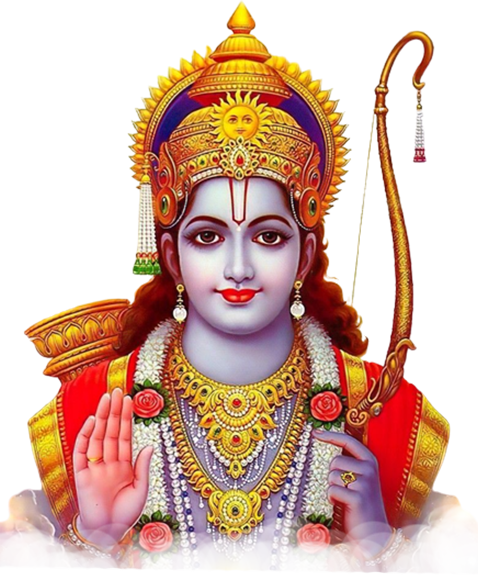
Ram is typically depicted holding a bow, the Kodand, and arrows, with a calm, composed expression, often accompanied by Sita at his side, Lakshman behind him, and Hanuman kneeling in devotion before him — an image called the Ram Parivar, representing ideal family harmony, duty and devotion together. His complexion is often shown as blue or dark, like Vishnu, signifying his infinite, boundless nature.
The epic of his life, the Ramayana, composed by the sage Valmiki, and later retold in Awadhi by the poet-saint Tulsidas as the Ramcharitmanas, remains one of the most influential texts in all of Indian civilisation, shaping language, art, theatre, values and family life for over two thousand years. The Ram Charit Manas in particular is recited, sung and performed as Ramlila in towns and villages across North India every year, especially during Navratri leading up to Dussehra.
Major temples dedicated to Ram include the newly consecrated Ram Mandir in Ayodhya, built at his believed birthplace, Ramanathaswamy Temple in Rameswaram where he is said to have worshipped Shiva before crossing to Lanka, and countless Ram temples across India and the diaspora. Devotees chant the Ram Raksha Stotra, the Hanuman Chalisa in his honour through Hanuman, and simply the name "Ram" itself, considered so powerful that its repetition, japa, is a complete spiritual practice on its own — Mahatma Gandhi's final words are widely remembered as "Hey Ram."
To remember Ram is to remember that greatness is not measured only by power but by the willingness to keep one's word, honour one's duties, and place righteousness above personal comfort, even when it is agonisingly difficult. This is why, above all his other titles, Indians simply call him Maryada Purushottam — the most ideal among men.
Quick guide
Before you begin
Mantra
Ram mantra
Shri Ram Jai Ram Jai Jai Ram
Chant slowly with devotion for courage, truth, protection, and mental peace.
Bhav
Benefits devotees pray for
FAQ
Common questions
Who is Lord Ram?
Lord Ram is the seventh avatar of Vishnu, born in Ayodhya, revered as Maryada Purushottam, the ideal man who upheld dharma through fourteen years of exile, the rescue of Sita from Ravan, and righteous kingship.
Why is Ram called Maryada Purushottam?
He is called Maryada Purushottam, meaning the most perfect upholder of moral limits, because he honoured every duty, as son, husband, brother and king, with unwavering righteousness, even at great personal cost.
What festivals celebrate Lord Ram?
Ram Navami celebrates his birth, Dussehra or Vijayadashami celebrates his victory over Ravan, and Diwali celebrates his return to Ayodhya after fourteen years of exile.
Who wrote the Ramayana?
The Ramayana was composed by the sage Valmiki. It was later retold in Awadhi by the poet-saint Tulsidas as the Ramcharitmanas, which is widely recited across North India.
Seek Lord Ram's Blessings
Book a puja dedicated to Lord Ram for righteousness, courage and family harmony.