
 या देवी सर्वभूतेषु मातृरूपेण संस्थिता
Goddess Kali is the fierce, time-transcending form of Adi Shakti who destroys ego and evil to protect her children.
In the vast family of Hindu goddesses, few forms are as powerful, misunderstood and deeply loved as Maa Kali. She is not a goddess of destruction for its own sake, but the form of the Divine Mother who destroys time itself, ego, ignorance and evil so that her children can live in truth and freedom. Her very name comes from the Sanskrit word Kaal, meaning time and death, because she is the power that governs and ultimately dissolves both.
Who Is Goddess Kali
Kali is one of the principal forms of Adi Shakti, the primordial cosmic energy, and is especially revered within the Shakta tradition as one of the Dus Mahavidyas, the ten great wisdom goddesses. She is described in the Devi Mahatmya as emerging from the forehead of Goddess Durga during her fierce battle with the demons Chanda and Munda, and later Raktabija, whose blood created a new demon with every drop that touched the ground. Only Kali, by drinking every drop of blood before it fell, could finally end that seemingly unstoppable enemy.
Her dark or blue-black complexion represents the vastness of space and the formless, infinite nature of ultimate reality, in which all colours and forms dissolve. Far from representing negativity, in Tantric philosophy darkness is understood as the womb from which all creation emerges and to which it eventually returns.
The Symbolism Behind Her Fierce Form
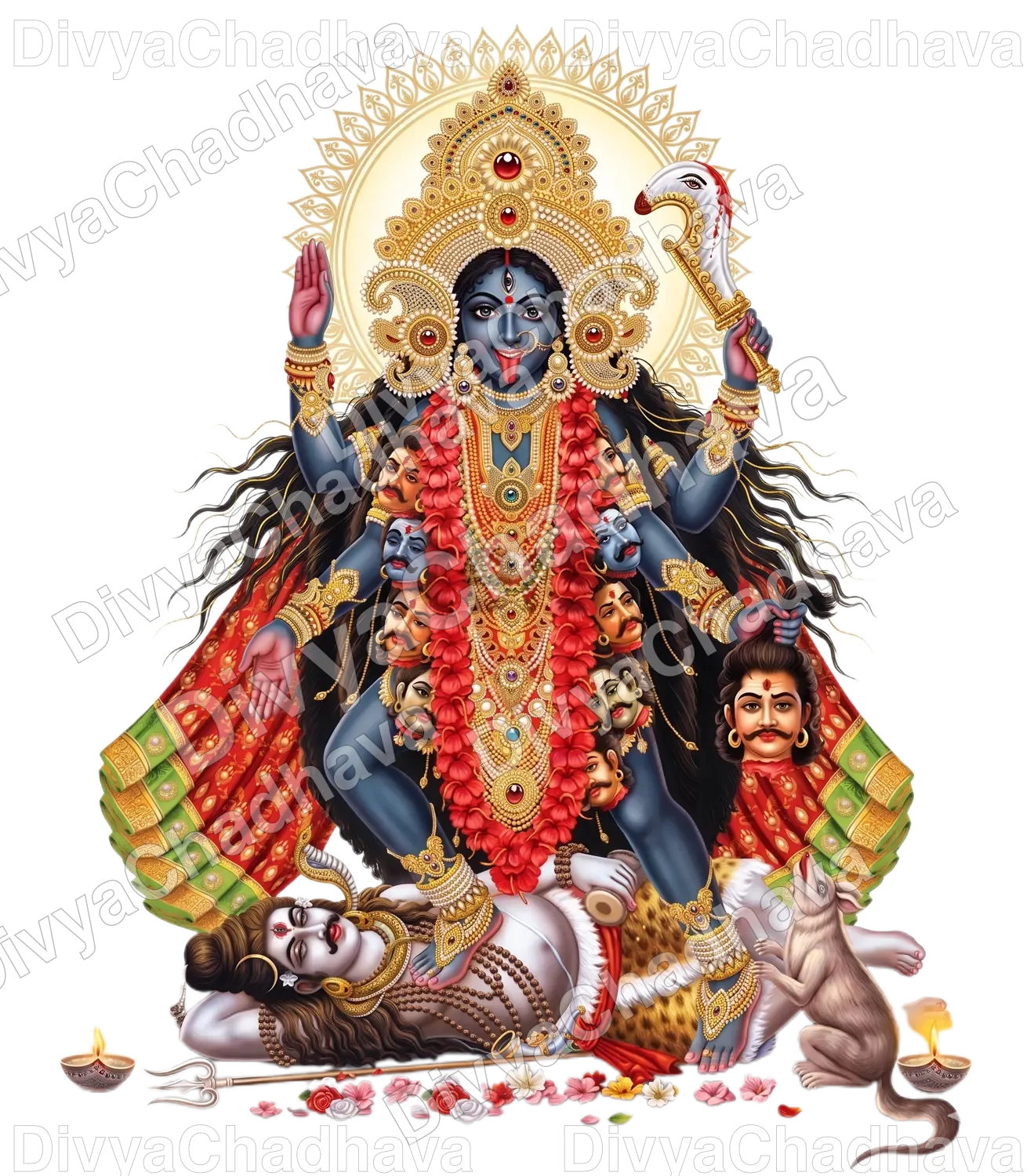
At first glance, Kali's iconography can appear frightening: a garland of skulls, a skirt of severed arms, a lolling red tongue, a sword in one hand and a severed head in another, while she stands upon the still body of Lord Shiva. Every element carries deep spiritual meaning.
The garland of fifty skulls represents the fifty letters of the Sanskrit alphabet, showing that Kali is the source of all sound, speech and mantra, the very fabric of creation. The severed heads and limbs symbolise the destruction of the ego and false identifications, the many masks that keep the soul bound to illusion. Her sword cuts through ignorance, and her outstretched tongue is often interpreted as a gesture of surprise or shame at stepping upon her own consort Shiva, or as the primal energy that must be tamed by pure consciousness.
Shiva lying beneath her feet is one of the most profound images in Hindu philosophy. Shiva represents pure, unmoving consciousness, while Kali represents Shakti, the dynamic power that acts, creates and destroys. Without Shakti, Shiva remains inert; without Shiva, Shakti has no ground to stand upon. Together they represent the complete, non-dual reality behind all existence.
Despite her terrifying appearance, Kali's eyes are always described as full of love, and her devotees, the great Bhaktas like Ramakrishna Paramahamsa, approached her not with fear but with the tenderness of a child running to its mother. She is called Dakshina Kali, the compassionate, protective form, precisely because true strength and true love are inseparable in her nature.
Origin and Puranic Stories
The most famous account of Kali's appearance is found in the Devi Mahatmya, part of the Markandeya Purana. When the demon army led by Shumbha and Nishumbha, along with their generals Chanda, Munda and Raktabija, threatened to overrun the three worlds, Goddess Durga manifested Kali from her own fury to destroy them. It was Kali who beheaded Chanda and Munda, earning the name Chamunda, and it was Kali who ultimately consumed Raktabija's self-replicating blood, ending his reign of terror.
Another beloved story describes how, after her fierce dance of destruction on the battlefield, Kali's rage grew so intense that the very stability of the universe was threatened. To calm her, Lord Shiva lay down in her path. When Kali realised she had stepped upon her own husband, she bit her tongue in shock and her fury subsided into serene compassion. This story is central to why she is worshipped as both the fierce protector and the loving mother who ultimately brings peace.
Famous Temples and Forms of Kali
Across India, Kali is worshipped in many forms. The Dakshineswar Kali Temple in West Bengal, made famous by Sri Ramakrishna Paramahamsa, and the Kalighat Kali Temple in Kolkata, one of the Shakti Peethas, are among her most revered shrines. Kamakhya Temple in Assam, though primarily associated with the goddess Kamakhya, is deeply connected to Shakta and Kali worship as well.
Her principal forms include Dakshina Kali, the gentle, boon-giving form most commonly worshipped in Bengal; Bhadrakali, an auspicious protective form; Shmashan Kali, associated with cremation grounds and the transcendence of death; and Mahakali, her cosmic, all-encompassing form associated with time and dissolution at the end of a cosmic cycle.
How Devotees Worship Maa Kali
Kali Puja, especially observed on Kali Chaudas and during Diwali in Bengal, Assam and Odisha, involves offerings of red hibiscus flowers, sindoor, sweets and, in traditional Tantric practice, the chanting of her beej mantra. Many devotees light diyas, recite the Kali Chalisa or Kali Stotra, and meditate upon her form to overcome fear, ego and worldly attachment.
Her most common beej mantra is Om Kreem Kalikayai Namah, chanted to invoke courage, protection from negative energies, and inner transformation. Devotees are advised to approach her worship with sincerity, discipline and guidance, remembering that her fierce form exists purely to remove obstacles and fear from the sincere seeker's path.
Why Kali Worship Endures
In every age, Maa Kali reminds devotees that true strength is not the absence of fierceness but its perfect union with love. She teaches that the ego, fear and illusion that bind us must sometimes be met with unflinching courage, and that the Divine Mother's protection is available to anyone who calls upon her with a sincere heart. This is why, across centuries and regions of India, Kali remains one of the most beloved and powerful forms of Devi worshipped today.
Quick guide
Before you begin
Mantra
Kali mantra
Om Kreem Kalikayai Namah
Chant with humility while praying for courage, protection, and transformation.
Bhav
Benefits devotees pray for
FAQ
Common questions
Is Goddess Kali evil or destructive in a negative sense?
No. Kali destroys ego, ignorance and evil forces to protect creation and her devotees, not out of malice. Her fierce form represents transformative power used for protection and liberation.
Why does Kali stand on Lord Shiva?
This image represents the union of Shakti, the dynamic active power, and Shiva, pure unmoving consciousness. Neither is complete without the other, and together they represent the whole of reality.
What is the meaning of Kali's beej mantra?
Om Kreem Kalikayai Namah invokes Kali's protective, transformative energy. Kreem is her seed sound representing creative divine power, and the mantra is chanted for courage, protection and inner strength.
Which day is best for Kali worship?
Tuesdays and Amavasya (new moon) are traditionally considered auspicious, along with the major festival of Kali Puja on Kali Chaudas during Diwali.
Seek Maa Kali's Blessings
Connect with divine protection and strength through an authentic puja performed with full Vedic vidhi.