 या देवी सर्वभूतेषु शक्तिरूपेण संस्थिता
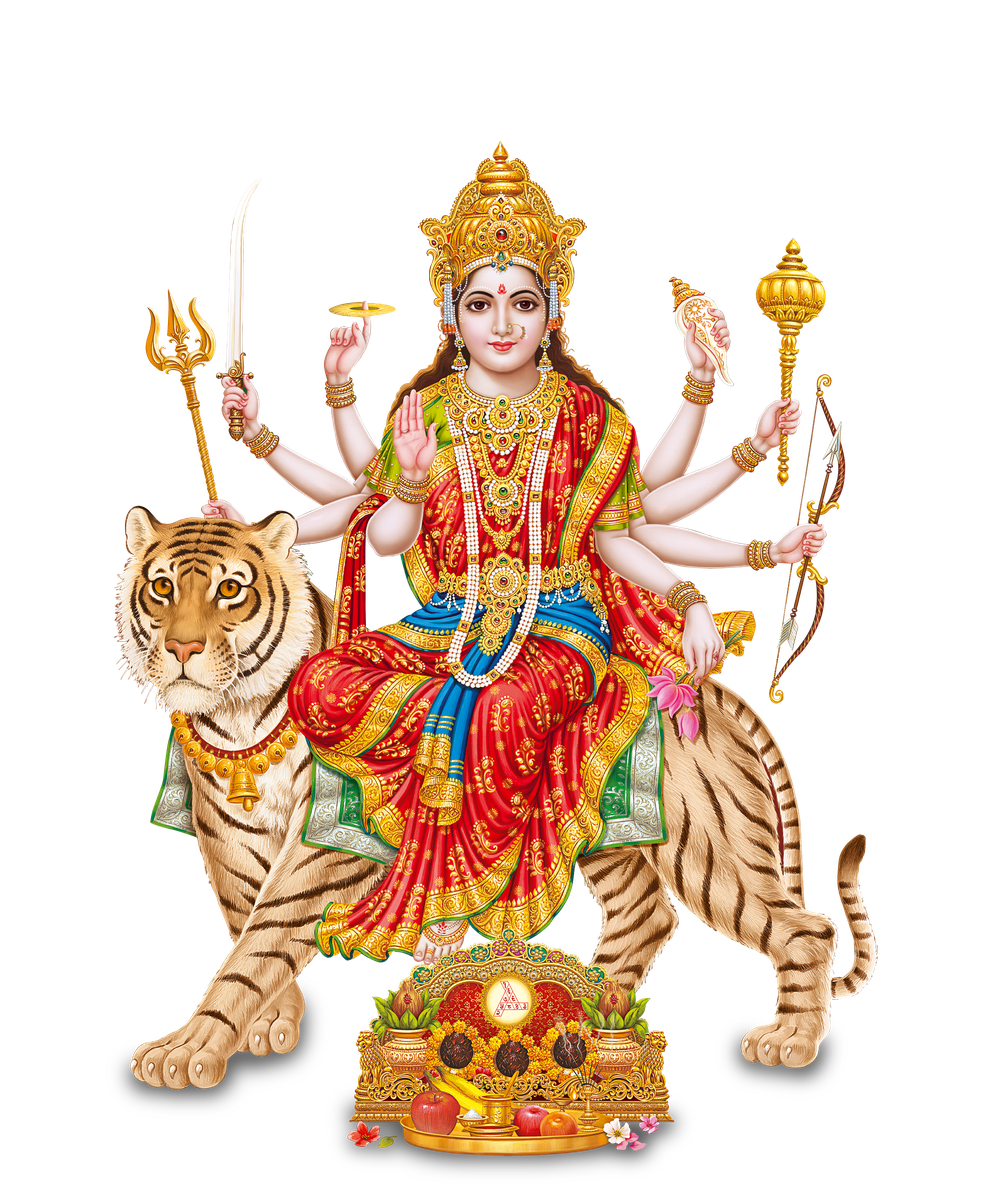
Goddess Durga is the fierce yet compassionate form of Adi Shakti, worshipped as the invincible warrior who destroys evil and protects her devotees.
Goddess Durga is one of the most revered forms of the Divine Mother in Sanatan Dharma. Her name comes from the Sanskrit word 'Durg', meaning a fort or something difficult to overcome, and 'Durga' means the one who is invincible, the one who removes all difficulties (durgati nashini). She is Adi Shakti herself, the primordial energy from which the entire universe manifests, and she is worshipped as the fierce protector who stands between her children and every form of adversity, whether worldly or spiritual.
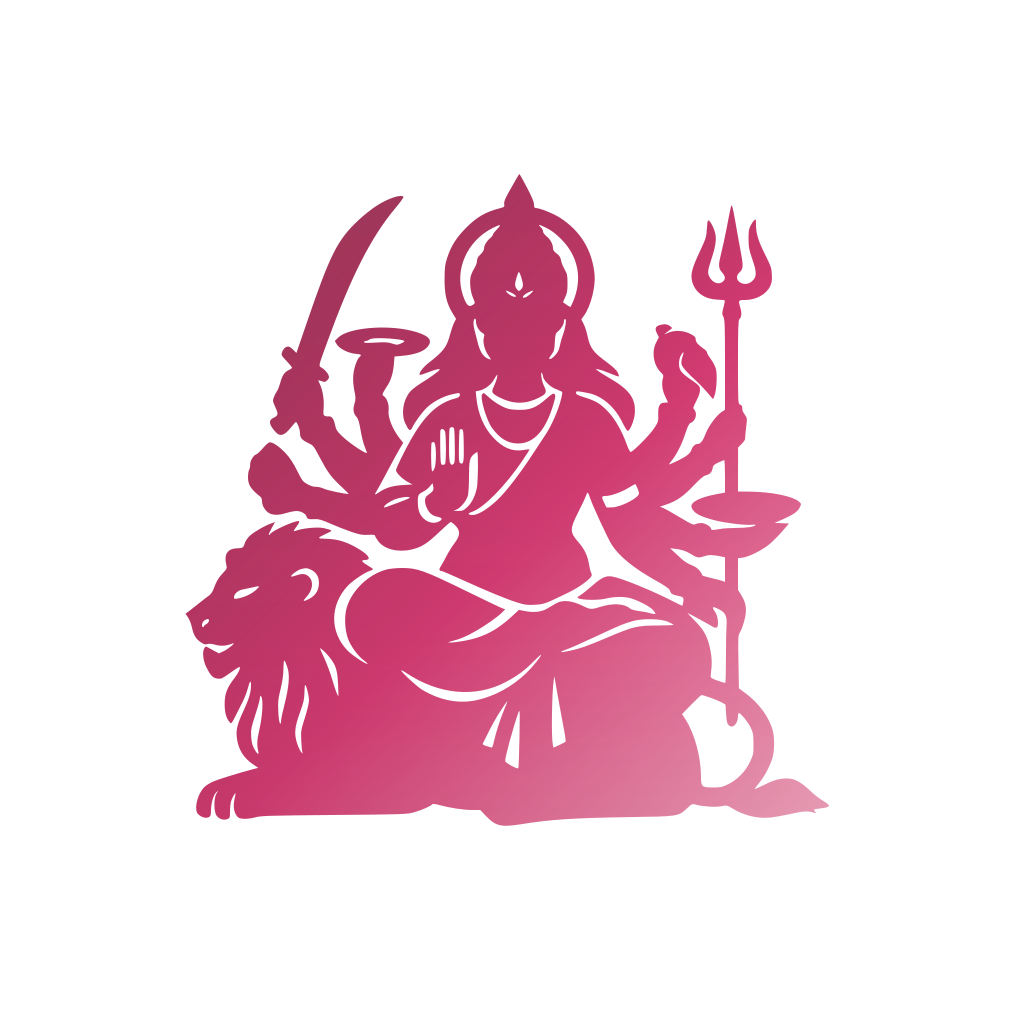
Unlike gentler forms of the Goddess, Durga is depicted as a warrior. She rides a lion or tiger, symbolizing raw power brought under divine control, and she carries an array of weapons in her many arms, each one gifted to her by a different god. Trishul from Shiva, Sudarshan Chakra from Vishnu, Vajra from Indra, a bow and arrows from Vayu, a sword from Chandra, and many more. This combined weaponry represents the truth that when dharma is threatened, all the powers of the universe converge into one Shakti to restore balance.
Origin of Goddess Durga: The Mahishasura Legend
The most famous account of Durga's origin appears in the Devi Mahatmyam, also called Durga Saptashati or Chandi Path, part of the Markandeya Purana. The demon Mahishasura, a buffalo-demon, had performed intense tapasya and received a boon that no man or god could kill him. Emboldened by this near-invincibility, he waged war on the Devas and drove them out of heaven.
Unable to defeat him, the Trimurti - Brahma, Vishnu, and Shiva - along with all the other gods, combined their divine energies. From this collective radiance emerged a resplendent female form, Goddess Durga. Each god gave her a weapon, Himavan gave her a lion to ride, and thus fully armed and radiant with the combined tejas of all the devas, she rode to the battlefield.
The battle between Durga and Mahishasura raged for nine days and nights. Mahishasura kept changing forms - buffalo, lion, elephant, man - trying to escape her power, but Durga matched every transformation. On the tenth day, as he emerged half in buffalo form and half in human form, she pierced him with her trishul and beheaded him with her sword, earning the name Mahishasuramardini, the slayer of Mahishasura. This victory of good over evil is celebrated every year as Navratri, culminating in Vijayadashami or Dussehra.
The Nine Forms: Navdurga
Durga is worshipped in nine distinct forms during the nine nights of Navratri, collectively called the Navdurga. Each form represents a stage of spiritual growth and a different aspect of her power.
Shailaputri, daughter of the mountain Himavan, representing the root of divine power and the strength of Mother Nature. Brahmacharini, the ascetic form who performed severe penance to attain Shiva as her consort, representing tapasya and self-discipline. Chandraghanta, whose forehead bears a half-moon shaped like a bell, representing courage and grace combined. Kushmanda, believed to have created the universe with her divine smile, representing the life-giving solar energy. Skandamata, the mother of Kartikeya, representing maternal love and protection. Katyayani, born to sage Katyayana, representing valor and the destroyer of evil. Kalaratri, the fiercest form, dark as night, representing the destruction of ignorance and fear. Mahagauri, radiant and fair, representing purity and peace after penance. Siddhidatri, the giver of all siddhis and perfections, representing the culmination of spiritual attainment.
Other Prominent Forms of Durga
Beyond the Navdurga, Durga manifests in many other well-known forms across scripture and worship. Chamunda, born from Durga's forehead to slay the demons Chanda and Munda. Jagadamba, the mother of the entire universe. Bhavani, the giver of life and existence. Vaishno Devi, worshipped in the holy cave shrine in Jammu, considered a combined form of Maha Kali, Maha Lakshmi, and Maha Saraswati. Ambe Maa, especially revered in Gujarat and Rajasthan. Each region of India has its own beloved local form of the Mother, but all are understood to be the same Adi Shakti.
Significance of Goddess Durga
Durga represents Shakti, the dynamic feminine energy without which even the gods are powerless. In the Devi Mahatmyam it is said that without Shakti, Shiva himself cannot even move - he becomes 'shava', a corpse. This teaches that consciousness and energy are inseparable, and the feminine principle is not secondary but the very source of all creation, preservation, and destruction.
Durga also represents the victory of dharma over adharma, of courage over fear, and of a mother's protective love that becomes fierce when her children are threatened. She is worshipped both as a gentle, nurturing mother and as an unstoppable warrior, teaching devotees that true strength includes both compassion and the courage to fight for what is right.
Famous Durga Temples
Vaishno Devi Temple in Jammu and Kashmir is among the most visited pilgrimage sites in India, where the Goddess resides as three sacred pindis in a cave. Kamakhya Temple in Guwahati, Assam, is one of the principal Shakti Peethas. Dakshineswar Kali Temple and Kalighat in Kolkata are deeply associated with Durga worship, especially during Durga Puja, West Bengal's grandest festival. Chamundeshwari Temple in Mysuru sits atop Chamundi Hill. Naina Devi in Himachal Pradesh and Jwala Ji Temple are also major Shakti Peethas connected to Durga's various forms. Across India there are 51 Shakti Peethas, each marking a place where a part of Sati's body is believed to have fallen, and Durga is worshipped at every one under a different local name.
How Devotees Worship Durga
Durga is worshipped through daily aarti and chanting of her names, especially during Navratri, which occurs twice a year in its major form (Chaitra and Sharad Navratri) and twice more as Gupt Navratri. Devotees observe fasts, recite the Durga Chalisa and Durga Saptashati, perform Kanya Pujan by honoring young girls as living forms of the Goddess, and offer red flowers, vermilion, coconut, and red cloth. The mantra 'Om Dum Durgayei Namah' and the longer 'Sarva Mangala Mangalye Shive Sarvartha Sadhike, Sharanye Trayambake Gauri Narayani Namostute' are chanted for protection, courage, and the removal of obstacles. Many devotees also perform a formal Durga Puja or Chandi Path at home or through a pandit for the fulfillment of wishes and family protection.
Quick guide
Before you begin
Mantra
Devi mantra
Om Dum Durgaye Namah
Chant 11, 21, or 108 times according to your time and capacity.
Bhav
Benefits devotees pray for
FAQ
Common questions
Who is Goddess Durga in simple words?
Goddess Durga is the warrior form of the Divine Mother (Adi Shakti), created from the combined energies of all the gods to defeat the demon Mahishasura and protect dharma. She represents courage, protection, and the victory of good over evil.
Why does Durga have so many arms and weapons?
Her multiple arms each hold a weapon gifted by a different deity - Shiva's trishul, Vishnu's chakra, Indra's vajra, and more - symbolizing that when evil threatens the world, the combined power of all divine forces manifests in her to restore balance.
What is the difference between Durga and the Navdurga?
Durga is the overarching form of the warrior Goddess, while Navdurga refers to her nine specific forms (Shailaputri to Siddhidatri) worshipped on each of the nine nights of Navratri, each representing a different stage of spiritual power.
Which is the best day to worship Durga?
Tuesdays and Fridays are traditionally auspicious for Durga worship, and the nine days of Chaitra and Sharad Navratri are considered the most powerful time to seek her blessings.
Seek Maa Durga's Blessings
Book a traditional Durga Puja performed by expert pandits for protection, strength, and the fulfillment of your wishes.