

 ॐ नमो भगवते वासुदेवाय
The origin, opening dhyana verses, closing phala shruti and complete meaning of the Vishnu Sahasranama, along with the correct way to recite it.
The Vishnu Sahasranama, the thousand names of Bhagwan Vishnu, is one of the most revered stotras in Sanatan Dharma. It appears in the Anushasana Parva of the Mahabharata, spoken by Bhishma Pitamah to Yudhishthira while lying on his bed of arrows, in answer to Yudhishthira's question about the one path, the one deity and the one chant by which a person may be freed from all sorrow. Bhishma's answer was to recite the thousand names of Vishnu — declaring that constant chanting and remembrance (japa and smarana) of Vishnu's names is the highest dharma for a person in any stage of life.
Opening Dhyana Shlokas (Devanagari)
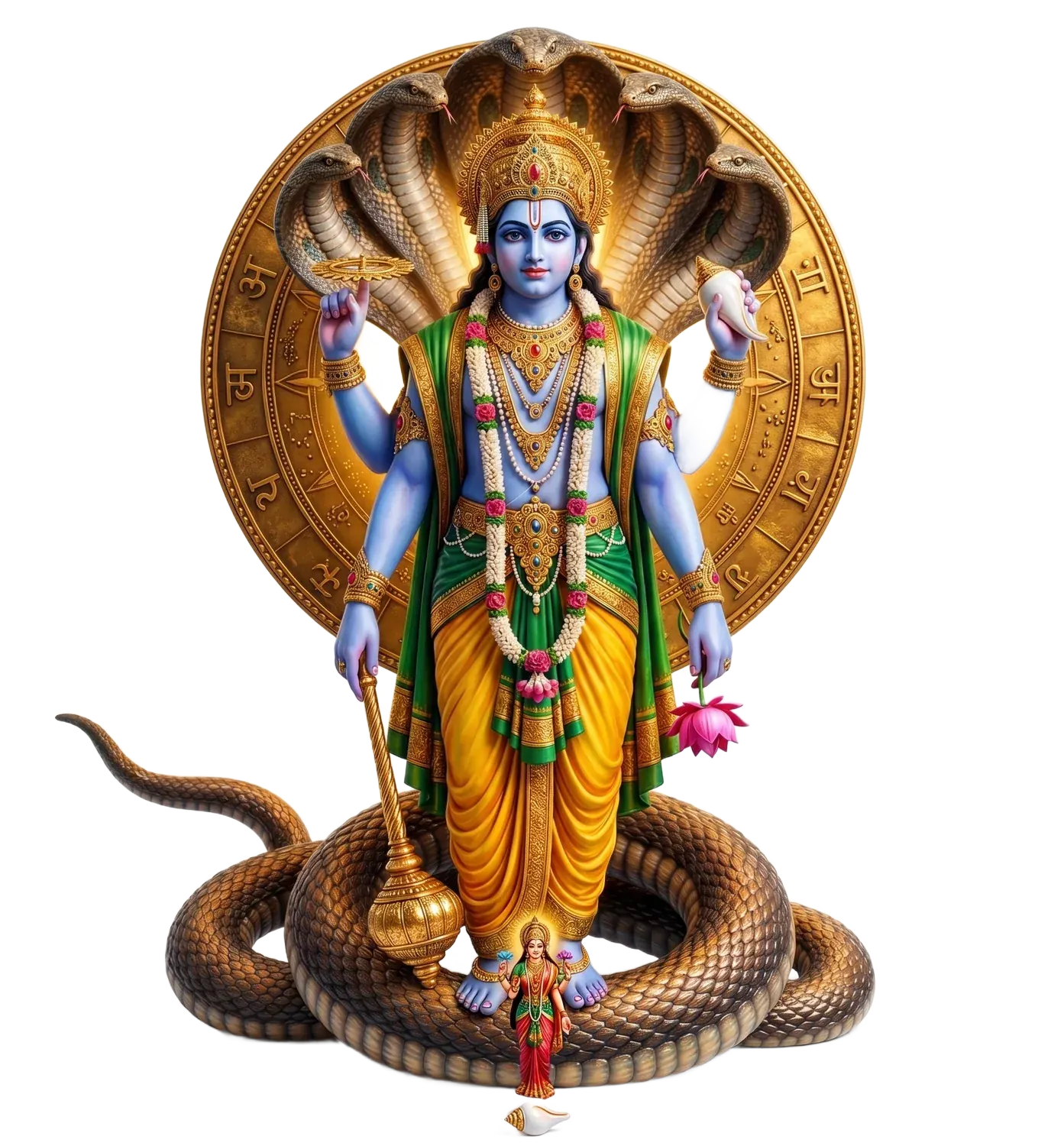
शुक्लाम्बरधरं विष्णुं शशिवर्णं चतुर्भुजम्। प्रसन्नवदनं ध्यायेत्सर्वविघ्नोपशान्तये॥
व्यासं वसिष्ठनप्तारं शक्तेः पौत्रमकल्मषम्। पराशरात्मजं वन्दे शुकतातं तपोनिधिम्॥
व्यासाय विष्णुरूपाय व्यासरूपाय विष्णवे। नमो वै ब्रह्मनिधये वासिष्ठाय नमो नमः॥
अविकाराय शुद्धाय नित्याय परमात्मने। सदैकरूपरूपाय विष्णवे सर्वजिष्णवे॥
यस्य स्मरणमात्रेण जन्मसंसारबन्धनात्। विमुच्यते नमस्तस्मै विष्णवे प्रभविष्णवे॥
ॐ नमो विष्णवे प्रभविष्णवे।
Structure and Nature of the Text
The Vishnu Sahasranama proper consists of 107 shlokas containing the thousand names of Vishnu, each name a distinct attribute, form, quality or glory of the Supreme Being — such as Vishvam (the universe itself), Vishnu (the all-pervading one), Vashatkara, Bhutabhrit, Bhavo, Bhutatma, Bhutabhavana, and so on through a thousand names, closing with the well-known culminating name often given as Sarva-prahar-anaayudhah. Reciting or reading each of the thousand names in full is a well-established, complete Sanskrit text traditionally printed with commentary (notably Adi Shankaracharya's bhashya); devotees are encouraged to obtain the full printed or recorded text for the complete 107-shloka recitation, since the entire text is long enough that we present here its origin, structure, opening and closing verses in full along with detailed meaning, benefits and method — while the complete uninterrupted japa of all thousand names is best done from a verified printed pothi or audio recording to preserve exact pronunciation.
Closing Phala Shruti (Devanagari)
या इदं शृणुयान्नित्यं यश्चापि परिकीर्तयेत्। नाशुभं प्राप्नुयात्किंचित्सोऽमुत्रेह च मानवः॥
वेदान्तगो ब्राह्मणः स्यात्क्षत्रियो विजयी भवेत्। वैश्यो धनसमृद्धः स्याच्छूद्रः सुखमवाप्नुयात्॥
धर्मार्थी प्राप्नुयाद्धर्ममर्थार्थी चार्थमाप्नुयात्। कामानवाप्नुयात्कामी प्रजार्थी चाप्नुयात्प्रजाम्॥
भक्तिमान्यः सदोत्थाय शुचिस्तद्गतमानसः। सहस्रं वासुदेवस्य नाम्नामेतत्प्रकीर्तयेत्॥
यशः प्राप्नोति विपुलं ज्ञातिप्राधान्यमेव च। अचलां श्रियमाप्नोति श्रेयः प्राप्नोत्यनुत्तमम्॥
न भयं क्वचिदाप्नोति वीर्यं तेजश्च विन्दति। भवत्यरोगो द्युतिमान्बलरूपगुणान्वितः॥
Meaning
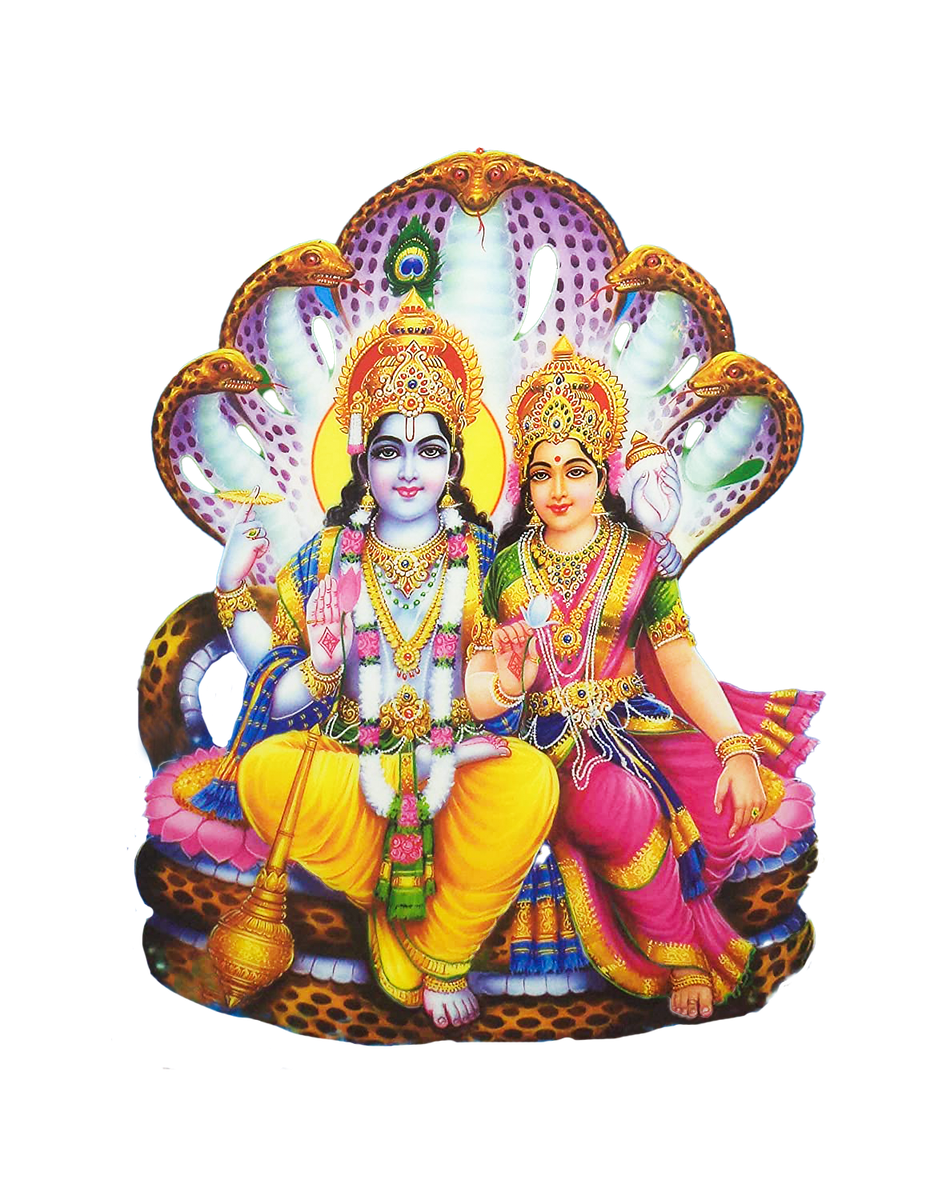
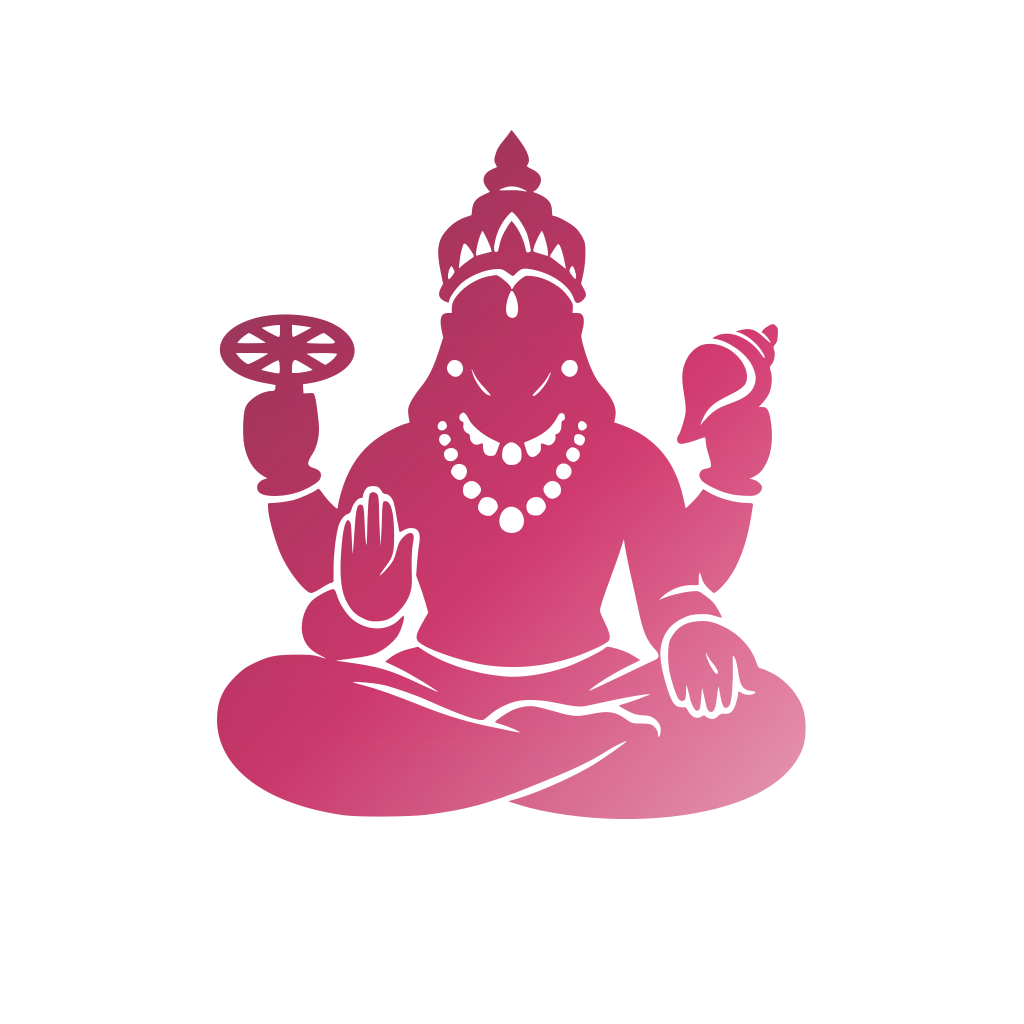
Opening verse: One should meditate upon Vishnu, who is clad in white garments, whose complexion is like the moon, who has four arms and a serene face, for the pacification of all obstacles.
The next verses salute Sage Vyasa, the compiler of the Mahabharata through whom this stotra has come to us, honouring his lineage and calling him an ocean of tapas (austerity), and equating him with Vishnu himself as the giver of divine knowledge.
The verse yasya smarana-maatrena affirms that mere remembrance of Vishnu's name frees a person from the bondage of birth and worldly cycle — a foundational promise of the entire stotra: that the path here is one of remembrance and chanting, accessible to all, not only ritual alone.
Phala shruti meaning: One who listens to this daily, or who recites it, attains no misfortune whatsoever, in this world or the next. A Brahmin who recites it becomes established in Vedanta; a Kshatriya becomes victorious; a Vaishya attains wealth; a Shudra attains happiness and ease. One seeking dharma attains dharma, one seeking wealth attains wealth, one seeking desires fulfilled attains them, and one seeking progeny attains good progeny. The devoted one who rises early, remains pure, and with a mind fixed on Vasudeva recites these thousand names attains abundant fame, prominence among kin, unwavering prosperity and the highest good. Such a person never experiences fear anywhere, gains vigour and radiance, becomes free of disease, and is endowed with strength, good form and virtuous qualities.
Significance of the Thousand Names
Each of the thousand names describes an aspect of Vishnu — as the sustainer of the universe (Bhutabhrit), the one who pervades all (Vishnu itself means 'the all-pervading'), the source of the Vedas, the destroyer of sorrow, the giver of liberation (Mokshada), and the embodiment of dharma itself. Chanting the names is considered equivalent to contemplating the entirety of Vishnu's cosmic form, since no single name can capture the infinite, and so a thousand are given so the devotee's mind may rest, in turn, on each facet of the divine.
How and When to Recite
Best day: Any day is suitable, but Thursday (Guruvar, associated with Vishnu-Brihaspati) and Ekadashi are especially favoured; the full text is also widely recited during Kartik month and on Vaikuntha Ekadashi.
Best time: Early morning (Brahma Muhurta) after bathing, seated facing east, before an image of Vishnu, Lakshmi-Narayan or Shaligram.
Method: Begin with the dhyana shlokas given above, then recite the complete 107-shloka text from a verified printed or audio source for accuracy, and close with the phala shruti verses.
Who may recite: The Sahasranama is open to all sincere devotees regardless of background; Bhishma himself tells Yudhishthira that constant remembrance of Vishnu's names is available to every person in every stage of life.
Simplified alternative: Devotees short on time may chant the single maha-mantra Om Namo Bhagavate Vasudevaya, considered a distilled essence of the entire Sahasranama, 108 times daily.
Benefits
Removal of obstacles, fear and misfortune from daily life, as promised in the phala shruti.
Steady prosperity, good name and standing appropriate to one's role and effort.
Inner peace and freedom from anxiety, since the mind is repeatedly turned toward the sustaining, protective nature of Vishnu.
A gradual purification of thought that supports both worldly wellbeing (bhukti) and spiritual progress toward liberation (mukti).
A Gentle Note
For the complete, word-perfect recitation of all thousand names, please use a verified printed text (such as the traditional edition with Adi Shankaracharya's commentary) or a trusted audio recording, so that the Sanskrit pronunciation remains accurate — this preserves the full power and sanctity of the stotra exactly as it has been transmitted for generations.
Quick guide
Before you begin
Mantra
Vishnu mantra
Om Namo Bhagavate Vasudevaya
Chant before katha or aarti while praying for protection, dharma, and peace.
Bhav
Benefits devotees pray for
FAQ
Common questions
Who first recited the Vishnu Sahasranama?
Bhishma Pitamah recited it to Yudhishthira from his bed of arrows, in the Anushasana Parva of the Mahabharata, in response to a question about the one path to freedom from sorrow.
Is it necessary to recite all 1000 names correctly?
Full accuracy matters for the traditional text, so devotees are encouraged to use a verified printed or audio version; those short on time may chant Om Namo Bhagavate Vasudevaya as a distilled alternative.
Who is eligible to recite the Sahasranama?
It is open to every sincere devotee regardless of background, since Bhishma himself taught it as accessible to people in every stage and station of life.
What is the best time to recite it daily?
Brahma Muhurta (before sunrise) after bathing is considered ideal, though it may be recited at any time with a clean mind and pure intention.
Seek Bhagwan Vishnu's Blessings
For a dedicated Vishnu or Satyanarayan puja with sankalp in your name, our pandits can perform it with complete vidhi.