

 Jyotish Shastra · Chapter 78
Chapter 78 — Lost Horoscopy
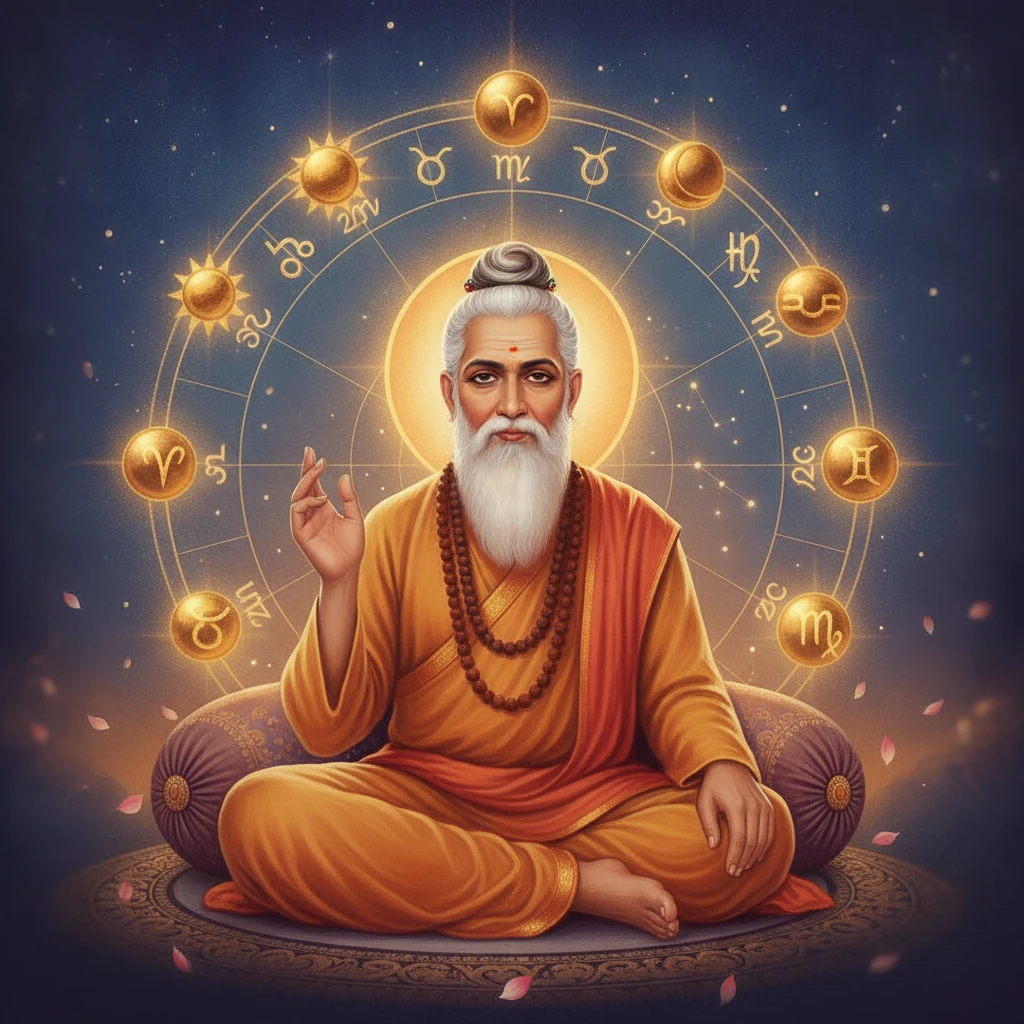
1-2. Maitreya said. O Sage! You have so far described the auspicious and inauspicious effects to be enjoyed, or suffered by a person on the basis of the time of birth, but can the auspicious and inauspicious be ascertained, when the time of birth is not known? Kindly tell me, if there is any way to solve this problem.
3-4. The Sage said. Your question is a good one and is for the benefit of the world at large. Considering your attachment, I will tell you about this problem also. If any, or all amongst the Samvatsar, Ayana, Ritu, month, Paksha, Tithi, Nakshatr, Lagn, Rāśi, or Amsas etc. of the birth are not known, these can be ascertained from Prasna Lagn (Query chart).
5-6. The Samvatsar of the birth of the querist will be the same, as that of the Rāśi in the Dwadasams, in which the Prasna Lagn falls (Guru will be in that Rāśi at birth). Saumyayan (Uttarayan - the northern course of Sūrya) will be in the first Hora of Lagn and Yamyayan (Dakshinayan - the southern course of Sūrya) will be in its second Hora. The Ritu (season) may be determined with reference to the Lord of the Drekkan, in which Lagn falls. Shishir will be indicated by the Drekkan of Śani, Grishma by that of Sūrya and Mangal, Vasanta by that of Śukr, Varsha by that of Candr, Sharad by that of Budh and Hemanta by that of Guru.
7. If there be any contradiction in the Ayana and Ritu, the Ritu may be determined from Budh in place of Mangal, from Śukr in place of Candr and from Śani in place of Guru.
8-9. After the Ritu becomes known take the first part of the Drekkan, as its first month and latter part, as the next month of the Ritu. Then from the expired Amsas of the Drekkan determine proportionately the Tithi, or the Amsas of Sūrya. The Istakal, indicated by the Amsas (degrees) of Sūrya, will be the time of the birth of the querist. From the Istakal so calculated have to be worked out the longitudes of the Grahas and Bhavas (Grah Spast and Bhava Spast). Predictions should then be made in accordance with the dispositions of the Bhavas and Grahas.
10. Maitreya asked. O Sage! Guru returns to the same Rāśi after every 12 years. Then from which circle of Guru should Samvatsar be determined.
11-12. The Sage said in reply. O Maitreya! When there is any doubt about the Samvatsar, take the approximate age of the querist and add multiples of 12 to the difference between the Rāśi of the Guru at the time of query and his Rāśi at the time of birth. The figure so arrived at should be taken, as the possible number of years and the Samvatsar should be determined accordingly. If by adding 12 there may appear to be difference in age, the position of Guru should be fixed, according to guessed approximate age, in the Trikon Rāśi, 5th, or 9th of the Prasna Lagn, as may be found feasible.
Then, taking that, as the Samvatsar, the Ayana, Ritu etc. should be worked out accordingly in the manner already explained.
13. Maitreya asked again. O Sage! How will the time of birth be known after ascertaining the month and the Amsas etc. of Sūrya. Please explain this for the benefit of the people. 14-16.The Sage said. After ascertaining the Rāśi, Amsas etc. of Sūrya at the time of birth, the longitude of Sūrya (Sūrya Spast) should be worked out for the next day after the number of days, taken by Sūrya after entering into the Rāśi, which will be equal to the expired Amsas of Sūrya. Then the difference between the longitudes of this rising Sūrya and Sūrya at the time of birth should be converted into Kalas and multiplied by
60. The product should be divided by Sūrya Spast, converted into Kalas. The Ghatikas etc. so becoming available will represent the Istakal of the birth before and after sunrise. If the longitude of the Ista Sūrya be more than that of the rising Sūrya, the Istakal of the birth will be so much after the sunrise. If the longitude of the Ista Sūrya be less than that of the rising Sūrya, the Istakal of the birth will be so much before the sunrise.
Quick guide
Before you begin
Bhav
Benefits devotees pray for
FAQ
Common questions
What does Chapter 78 of the Brihat Parashara Hora Shastra cover?
Chapter 78, "Lost Horoscopy", is part of the Brihat Parashara Hora Shastra, the foundational classical text of Vedic astrology attributed to Maharishi Parashara. You can read the full chapter above.
What is the Brihat Parashara Hora Shastra?
The Brihat Parashara Hora Shastra (BPHS) is the most authoritative classical treatise on Vedic astrology (Jyotish), traditionally taught by Maharishi Parashara to his disciple Maitreya. Its 97 chapters cover creation, the grahas (planets), rashis (signs), houses, divisional charts, dashas and remedies.
Get your Vedic astrology reading
Have your kundali analysed by the principles of this classical granth. Explore the Jyotish tools, or read on in Sanatan Sahitya.