

 Hare Krishna Hare Krishna
Lord Krishna, the eighth avatar of Vishnu, is the playful child of Vrindavan, the wise charioteer of the Gita, and the eternal friend of every devotee.
Few figures in world spirituality carry as much warmth, wisdom and wonder as Lord Krishna. He is worshipped simultaneously as the mischievous, butter-stealing child of Vrindavan, the enchanting flute player who danced the Raas Leela under the full moon, the wise and unwavering charioteer who delivered the Bhagavad Gita on the battlefield of Kurukshetra, and the supreme godhead himself, of whom Vishnu's avatars are said to be expansions. Krishna is Purna Avatar, the complete and full descent of the divine, unlike partial avatars that carry only a portion of divine power.
Krishna was born in a prison cell in Mathura to Devaki and Vasudev, during a time when the tyrant king Kansa, Devaki's own brother, had imprisoned them after a prophecy foretold that Devaki's eighth child would be his destroyer. On the dark, storm-lashed night of his birth, Janmashtami, Vasudev carried the newborn Krishna across a flooding Yamuna river to Gokul, exchanging him for a baby girl to protect him from Kansa's wrath. This night is still celebrated every year across India and the world as one of the most joyous festivals in the Hindu calendar.
Krishna's childhood in Vrindavan and Gokul, raised by his foster parents Nanda and Yashoda, is filled with leelas, divine plays, that are cherished across generations. As an infant, he crawled and stole butter from neighbours' homes with such charm that even his victims could not stay angry. He lifted the great Govardhan Parvat on the tip of his little finger for seven days to shelter the villagers of Vrindavan from Indra's furious storm, teaching that true devotion outweighs even the pride of the gods. He tamed the venomous serpent Kaliya in the Yamuna, danced upon its hoods, and drove it away without killing it, a lesson in strength tempered by mercy. And with his cowherd friends and the gopis, the milkmaids of Vrindavan, he played his flute so sweetly that all of nature paused to listen, and performed the Raas Leela, a divine circular dance symbolising the soul's longing union with the supreme.
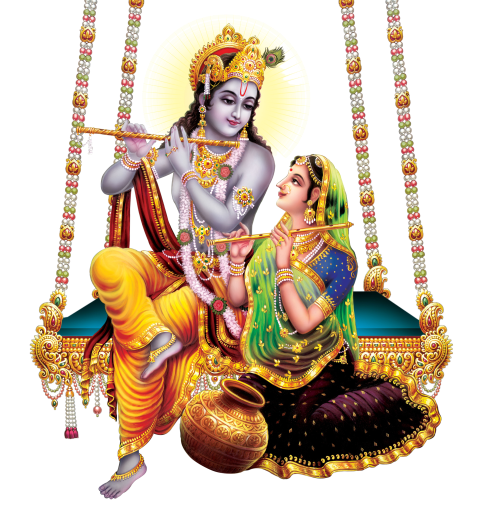
Among the gopis, Radha holds the most exalted place. Radha and Krishna together represent the ultimate ideal of divine love, prem, a love so pure and selfless that it transcends worldly desire and becomes the highest form of bhakti, devotion. Even today, devotees greet each other with the words "Radhe Radhe" or "Radha Krishna," honouring this eternal, inseparable pair.
As Krishna grew, he returned to Mathura and, in a dramatic confrontation, killed the cruel king Kansa, freeing his true parents and restoring rightful rule. Later, to protect his people the Yadavas from repeated invasions, he established the magnificent city of Dwarka on the western coast, a city of gold and prosperity that legend says was eventually reclaimed by the sea.
Krishna's greatest role in later life was as a statesman, diplomat, guide and, ultimately, teacher during the great war of the Mahabharata. As cousins and kingdoms were drawn into a devastating conflict between the righteous Pandavas and the scheming Kauravas, Krishna chose not to fight himself but to serve as charioteer to Arjuna, the greatest of the Pandava warriors. When Arjuna, standing on the battlefield of Kurukshetra and seeing his own relatives, teachers and friends arrayed against him, was overcome with grief and refused to fight, Krishna delivered to him the Bhagavad Gita, an eighteen-chapter discourse on duty, the nature of the soul, the paths of devotion, action and knowledge, and the ultimate reality of the divine. The Gita remains one of the most profound spiritual texts ever composed, studied and revered not only by Hindus but by seekers, philosophers and leaders across the world. In it Krishna famously declares his promise to return in every age that dharma declines, and reveals his Vishwarupa, his cosmic universal form, to Arjuna as proof of his true nature.
Krishna's life carries lessons at every stage. His childhood teaches the innocence and joy of pure devotion. His youth in Vrindavan teaches love, playfulness and the soul's yearning for the divine. His governance of Mathura and Dwarka teaches responsible, protective leadership. And his role in the Mahabharata teaches duty without attachment to outcome, the famous principle of nishkama karma, selfless action, which forms the philosophical heart of the Gita.
Krishna is usually depicted with blue-tinged skin symbolising the infinite, boundless nature of the sky and ocean, dressed in yellow silk, wearing a peacock feather in his crown, playing a flute, often accompanied by cows, which represent gentleness, abundance and the pastoral ideal. His many names reflect his many facets: Govinda, protector of cows; Madhusudan, destroyer of the demon Madhu; Vasudev, son of Vasudev; Gopal, the cowherd; Murlidhar, holder of the flute; and Yogeshwar, lord of yoga.
Major temples dedicated to Krishna include the Krishna Janmabhoomi temple in Mathura, built at his believed birthplace, the Banke Bihari and other temples across Vrindavan, the ancient Dwarkadhish temple in Dwarka, Gujarat, and the Guruvayur temple in Kerala. Janmashtami, his birthday, is celebrated with midnight prayers, fasting, devotional singing and the enactment of his childhood leelas, while Holi, the festival of colours, is deeply associated with the playful colour-throwing traditions of Vrindavan and Barsana, Radha's birthplace.
Devotees relate to Krishna in every possible mood, called bhava: as a parent adoring a mischievous child, as a friend, sakha, sharing life's joys and struggles, as a lover longing for union, and as a student receiving the highest wisdom from a divine teacher. This range is unique to Krishna among Hindu deities and is one reason his worship, Krishna bhakti, has produced some of the richest devotional poetry, music, dance and art in the entire Hindu tradition.
To know Krishna is to understand that the divine can be both utterly playful and profoundly wise, both intimately close as a friend and infinitely vast as the source of the entire cosmos. His life, from the prison cell in Mathura to the battlefield of Kurukshetra, remains one of the most complete and beloved stories in all of Sanatan Dharma.
Quick guide
Before you begin
Mantra
Krishna mantra
Om Kleem Krishnaya Namah
Chant with love and surrender, especially before Krishna katha, aarti, or bhog.
Bhav
Benefits devotees pray for
FAQ
Common questions
Who is Lord Krishna?
Lord Krishna is the eighth avatar of Vishnu, considered a Purna Avatar, the complete descent of the divine. He is known for his childhood leelas in Vrindavan, his love with Radha, and for delivering the Bhagavad Gita to Arjuna.
Where was Krishna born?
Krishna was born in a prison in Mathura to Devaki and Vasudev, and was raised in Gokul and Vrindavan by his foster parents Nanda and Yashoda.
What is the Bhagavad Gita?
The Bhagavad Gita is Krishna's eighteen-chapter discourse to Arjuna on the battlefield of Kurukshetra, covering duty, the soul, devotion, and selfless action. It is one of the most revered spiritual texts in the world.
Which festival celebrates Krishna's birth?
Janmashtami celebrates Krishna's birth, observed with midnight prayers, fasting and devotional singing. Holi is also closely associated with his playful leelas in Vrindavan and Barsana.
Seek Lord Krishna's Blessings
Book a puja dedicated to Lord Krishna for love, wisdom and protection in your life.