

 Jai Hanuman Gyan Gun Sagar
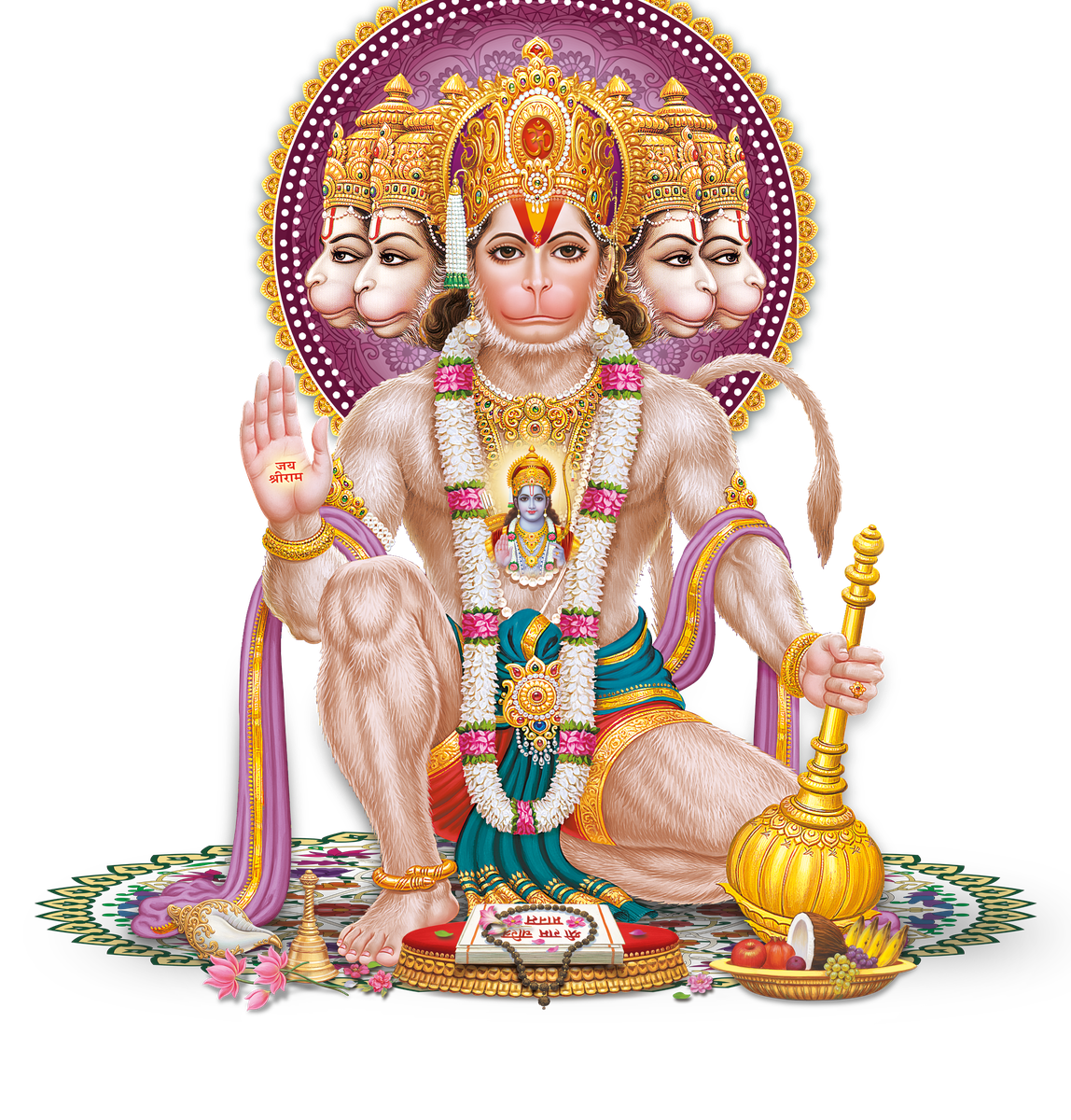
Lord Hanuman, the son of Vayu, is the mighty vanar devotee of Ram, revered for his boundless strength, wisdom, humility and unwavering bhakti.
Among all the beloved figures of Hindu devotion, few are approached with as much trust, warmth and confidence as Lord Hanuman. He is the vanar, the monkey-form deity, son of the wind god Vayu and the celestial nymph Anjana, whose entire life is a living demonstration of what perfect devotion, bhakti, looks like in action. Where Ram represents the ideal of righteous duty and Krishna represents the ideal of loving surrender, Hanuman represents the ideal of the devotee himself — someone whose strength, intellect and power are all placed entirely, unconditionally, in service of the divine.
Hanuman's birth is described in various Puranic accounts as the result of Vayu, the wind god, carrying a portion of divine energy meant for Dasharath's yajna to Anjana, who was performing penance for a child. Even as an infant, Hanuman displayed extraordinary power, once leaping toward the sun mistaking it for a fruit, an act that led the gods to bestow upon him numerous boons: invulnerability to most weapons, the ability to change his size at will, immense strength, the power of flight, and near immortality, tempered by a curse of temporary forgetfulness of his own powers that would only be lifted when someone reminded him of them at the right moment.
Hanuman's central role unfolds in the Ramayana, when he meets Ram and Lakshman in the forest during their search for the abducted Sita. As minister to the exiled monkey king Sugriv, Hanuman recognises Ram's divinity immediately and dedicates himself, body, mind and soul, to his service. He helps forge the alliance between Ram and Sugriv, and it is Hanuman who is chosen for the most crucial mission of the entire epic: to leap across the vast ocean to Lanka in search of Sita.
This leap, one of the most celebrated moments in Hindu literature, shows Hanuman growing to an immense size, overcoming demons and obstacles in the sea, and reaching Lanka, where he finds Sita held captive in the Ashok Vatika. He offers her Ram's ring as proof of his mission, comforts her with the promise of rescue, and, before returning, allows himself to be captured and his tail set on fire by Ravan's soldiers, only to use that very fire to burn a portion of Lanka, a display of controlled, purposeful power rather than mere destruction. This episode is called Lanka Dahan.
During the great war that followed, Hanuman's strength proved decisive again and again, most famously when Lakshman was gravely wounded and only the Sanjeevani herb from the Himalayas could save him. Unable to identify the exact herb in time, Hanuman lifted the entire Dronagiri mountain and flew it to the battlefield, ensuring Lakshman's life was saved. This act is remembered as the ultimate symbol of Hanuman's combination of devotion and decisive action, choosing certainty over delay when a life was at stake.
After the war, when Ram was crowned king of Ayodhya, he offered Hanuman many gifts, but Hanuman, true to his selfless nature, asked for nothing except to remain forever in Ram's service and devotion. A famous legend recounts how Sita once gave Hanuman a pearl necklace, and he was seen breaking each pearl open, looking inside, and discarding it. When asked why, he explained he was searching for Ram and Sita within each pearl, for without their presence the pearls held no value to him. When mockingly asked if Ram and Sita lived within his own heart, Hanuman tore open his chest to reveal Ram and Sita enshrined literally within it, proving his devotion was not performance but absolute truth. This image, Hanuman revealing Ram and Sita in his heart, remains one of the most powerful symbols of bhakti in the entire tradition.
Hanuman is considered a Chiranjivi, one of the immortals who remain alive on earth even today, and is believed to still visit wherever the Ramayana or his own Hanuman Chalisa is recited with true devotion. This belief keeps his worship alive not as history alone but as living, present relationship.
Hanuman is worshipped for very specific and practical reasons that make him one of the most widely approached deities in daily Hindu life. He is invoked for protection from evil spirits, negative energy, fear and black magic, since his very presence is said to repel darkness. He is invoked for physical strength, courage and the removal of obstacles in difficult undertakings. He is invoked by students and scholars for intellect and memory, since he himself is called Gyan Gun Sagar, the ocean of wisdom and virtue, having mastered all scriptures and grammar. And he is invoked simply as a shield of protection, worn as a locket, painted on doors, or recited about each morning, especially by those facing hardship, illness or danger.
The Hanuman Chalisa, composed by Tulsidas, is the most widely recited devotional text dedicated to him across the Hindu world, chanted daily by millions for protection, strength and peace of mind. Tuesday and Saturday are considered especially sacred days for his worship, when devotees visit his temples, offer sindoor, red vermillion mixed with oil, in remembrance of the legend that he once smeared his entire body with sindoor upon learning that Sita applied it for Ram's long life, reasoning that if a little sindoor pleased Ram, his entire body covered in it would please Ram infinitely more.
Major temples dedicated to Hanuman include the Sankat Mochan temple in Varanasi, the Salasar Balaji temple in Rajasthan, the Hanuman Garhi temple in Ayodhya, and countless neighbourhood temples across every town and village in India, often the most frequently visited shrine of all because devotees feel they can approach him without hesitation, in any state of difficulty, and be heard.
Hanuman's life carries a timeless lesson: that true strength is not measured by what power one possesses but by how completely that power is surrendered in loving service to what is right. He remains, to this day, the model devotee, the protector who never sleeps, and the eternal reminder that faith, humility and courage together can overcome any obstacle.
Quick guide
Before you begin
Mantra
Hanuman mantra
Om Hanumate Namah
Chant on Tuesday or Saturday for strength, protection, and devotion.
Bhav
Benefits devotees pray for
FAQ
Common questions
Who is Lord Hanuman?
Lord Hanuman is the vanar son of Vayu, the wind god, and the greatest devotee of Lord Ram. He is celebrated for his boundless strength, wisdom and unwavering bhakti, most famously shown in the Ramayana.
What are Hanuman's powers?
Hanuman has the power to fly, change size at will, immense physical strength, near invulnerability, and deep scriptural wisdom. He is considered a Chiranjivi, an immortal who still walks the earth.
Why do people worship Hanuman for protection?
Hanuman's presence is believed to repel negative energy, fear and black magic, so devotees invoke him for protection, courage and removal of obstacles, especially in difficult times.
Which day is best for Hanuman worship?
Tuesday and Saturday are considered especially sacred for Hanuman worship, along with Hanuman Jayanti, his birth anniversary, when devotees recite the Hanuman Chalisa and offer sindoor.
Seek Lord Hanuman's Blessings
Book a puja dedicated to Lord Hanuman for protection, strength and courage in your life.