
 छाया ग्रह गोचर
Understand how Rahu and Ketu's roughly 18-month sign transit shapes your ambitions, confusion, detachment and destiny — and the dharmic remedies to stay steady through it.
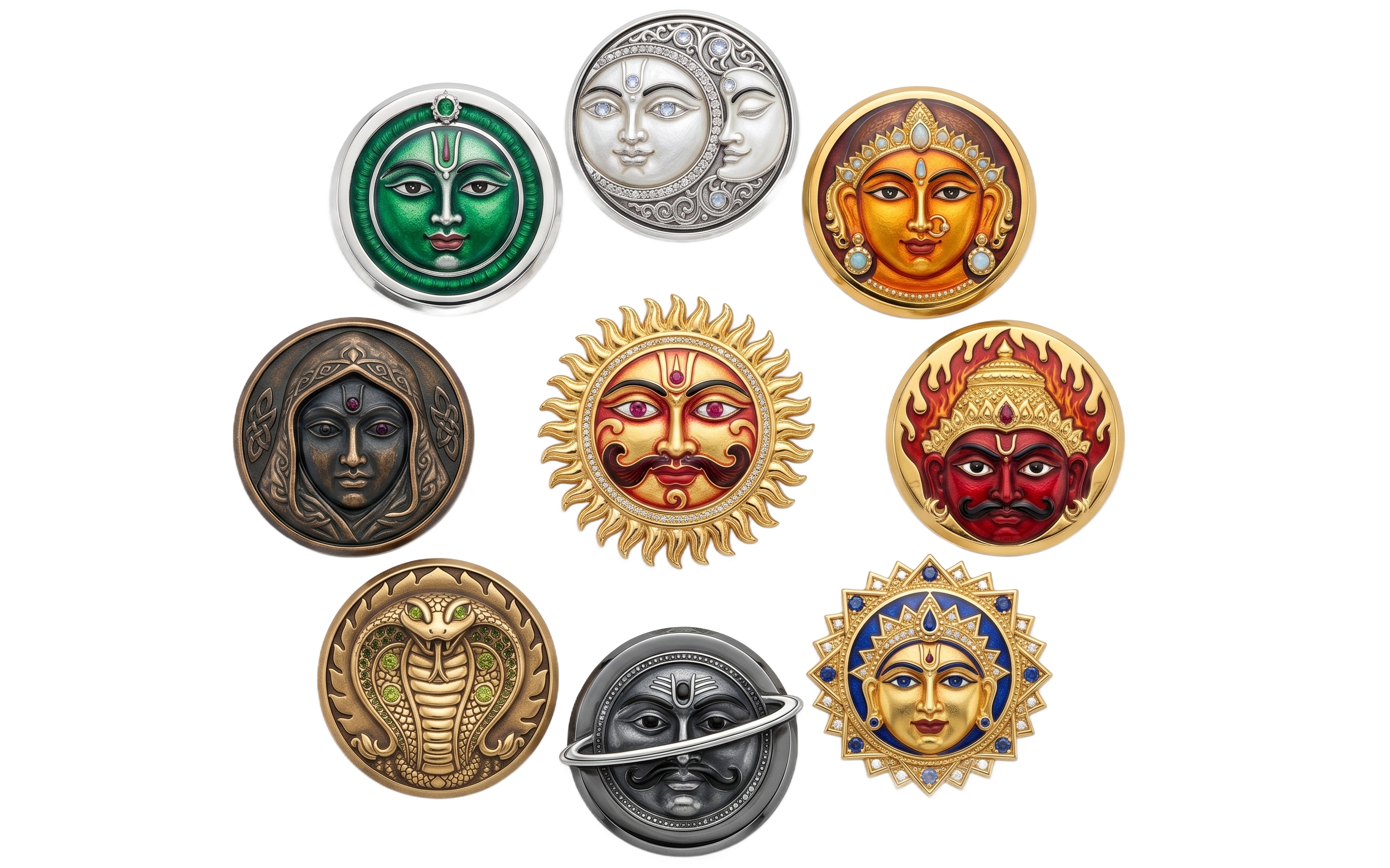
Rahu and Ketu are not physical planets but two mathematical points — the North and South lunar nodes — where the Moon's orbit crosses the Sun's apparent path (the ecliptic). In Vedic jyotish they are treated as powerful chhaya grahas, shadow planets, always positioned exactly 180 degrees apart. Wherever Rahu sits in a chart, Ketu sits in the opposite sign. This is why their gochar, or transit, is always studied together — you cannot understand one without the other.
Unlike other planets, Rahu-Ketu move retrograde through the zodiac, and they change signs together roughly once every eighteen months, spending about a year and a half in each rashi. Because their transit is slow and long, its effects are not sudden shocks like a Shani sade-sati mood swing, but a gradual reshaping of the themes of life connected to the houses they occupy from your Moon sign (Chandra Rashi) and Ascendant (Lagna).
What Rahu and Ketu represent
Rahu is the significator of worldly desire, ambition, foreign connections, technology, sudden gain, obsession and illusion (maya). When Rahu transits a house, it inflates and amplifies the matters of that house — often bringing rapid growth, but growth built on restlessness, craving and sometimes shortcuts that do not last.
Ketu is the significator of detachment, spirituality, moksha, intuition, and the results of past-life karma. Ketu's transit through a house tends to create a feeling of disinterest, confusion or letting go in that area of life — even when things appear outwardly fine, the native feels an inner pull away from it.
Because they always sit opposite each other, one house in your chart is being "inflated" by Rahu while the exactly opposite house is being "deflated" by Ketu, during the same period. This creates a push-pull dynamic — desire and gain in one area, detachment and release in the other.
How the Gochar affects the twelve houses
When Rahu-Ketu transit your 1st and 7th houses (from Moon or Lagna), the axis of self versus partnership is activated — questions of identity, marriage and partnerships come to the fore, sometimes with confusion about who you are in relation to others.
When they transit the 2nd and 8th houses, family, speech, wealth and sudden transformation, inheritance or hidden matters are highlighted — finances can see unexpected swings.
The 3rd and 9th house transit touches courage, siblings, short journeys versus your father, guru, fortune and dharma — long-held beliefs may be tested and revised.
The 4th and 10th house transit is one of the most talked-about, as it affects home, mother, inner peace versus career, status and public reputation — many people experience career upheavals, relocation, or a reassessment of what "home" means during this period.
The 5th and 11th house transit touches children, intelligence, romance versus gains, income and social circles — creative or academic pursuits can take unusual, non-traditional directions.
The 6th and 12th house transit is linked to health, debt, service versus losses, foreign residence, and spiritual withdrawal — this period often brings either health scares that resolve with lifestyle correction, or an unusual pull toward foreign lands or solitary spiritual practice.
General signs of Rahu-Ketu gochar influence
Many people going through an active Rahu-Ketu transit period notice a cluster of experiences: a sudden, almost obsessive interest in a new field or technology; unusual dreams or a pull toward the mystical; a feeling of being unable to settle, as if chasing something just out of reach; unexpected gains that come with equally unexpected complications; or conversely, a sudden and unexplainable loss of interest in something they once cared about deeply. None of these are fixed outcomes — they are tendencies that a person's own karma, effort and remedial measures shape.
Dharmic remedies during Rahu-Ketu gochar
Our tradition offers gentle, protective practices rather than fear-based ones. Chanting the Rahu beej mantra "Om Bhram Bhreem Bhraum Sah Rahave Namah" and the Ketu beej mantra "Om Sram Sreem Sraum Sah Ketave Namah" on Saturdays is widely recommended. Worship of Bhairav, Durga or Ganesha helps steady the mind against Rahu's restlessness. Feeding black dogs, offering til (sesame) and blankets to the needy, and observing simple fasts on Saturdays are traditional acts of daan associated with easing shadow-planet unease. Wearing gomed (hessonite) for Rahu or lehsunia (cat's eye) for Ketu is sometimes suggested by astrologers after examining a full chart, but gemstones should never be worn on guesswork — always after proper consultation.
Above all, the wisest response to any Rahu-Ketu period is grounded, dharmic living: honesty in dealings, patience with sudden opportunities that seem "too good", and continued devotion. This transit tests attachment and detachment in equal measure, and conscious, faith-rooted living is the surest way to pass through it gracefully.
A gentle note: this article explains general Vedic astrological principles for educational and devotional purposes. It is not a substitute for a personalised chart reading by a qualified jyotish acharya, nor for professional medical, legal or financial advice. Effects vary by individual chart, and no transit is purely fixed — sincere effort, remedy and grace always play a part.
Quick guide
Before you begin
Mantra
Rahu mantra
Om Bhram Bhreem Bhraum Sah Rahave Namah
Chant 108 times with discipline, especially when praying for relief from hidden obstacles.
Bhav
Benefits devotees pray for
FAQ
Common questions
How long does Rahu-Ketu gochar affect one house?
Since Rahu-Ketu remain in one sign for roughly 18 months, their effect on the corresponding houses of your chart typically plays out over that same period, with the most intense phase usually in the middle of the transit.
Is Rahu-Ketu transit always negative?
No. Rahu can bring genuine growth, opportunity and worldly success, while Ketu can bring spiritual insight and freedom from unnecessary attachments. The challenge lies in the restlessness or detachment they bring, not in the outcome itself being bad.
Can remedies really change the effect of this transit?
Dharmic tradition holds that mantra, daan and steady devotional practice help a person respond to a transit with wisdom and balance rather than impulsiveness — they support your own effort, they are not a guaranteed override of karma.
Should I wear gomed or cat's eye during this transit?
Only after a qualified astrologer examines your full birth chart. Gemstones are powerful and chart-specific; wearing them without proper analysis is not advised.
Seek Guidance for Your Rahu-Ketu Transit
Book a personalised puja or havan to seek balance and protection during your current Rahu-Ketu gochar period.