

 राहु-केतु की छाया
Understand what Kaal Sarp Dosh really means, how it forms in a birth chart, its 12 recognised types, and gentle dharmic remedies to find peace.
Kaal Sarp Dosh is one of the most widely discussed yog-doshas in Vedic astrology, often surrounded by fear and misunderstanding. This article explains clearly what it actually means, how astrologers identify its type, and the dharmic remedies traditionally recommended for peace of mind.
What Is Kaal Sarp Dosh
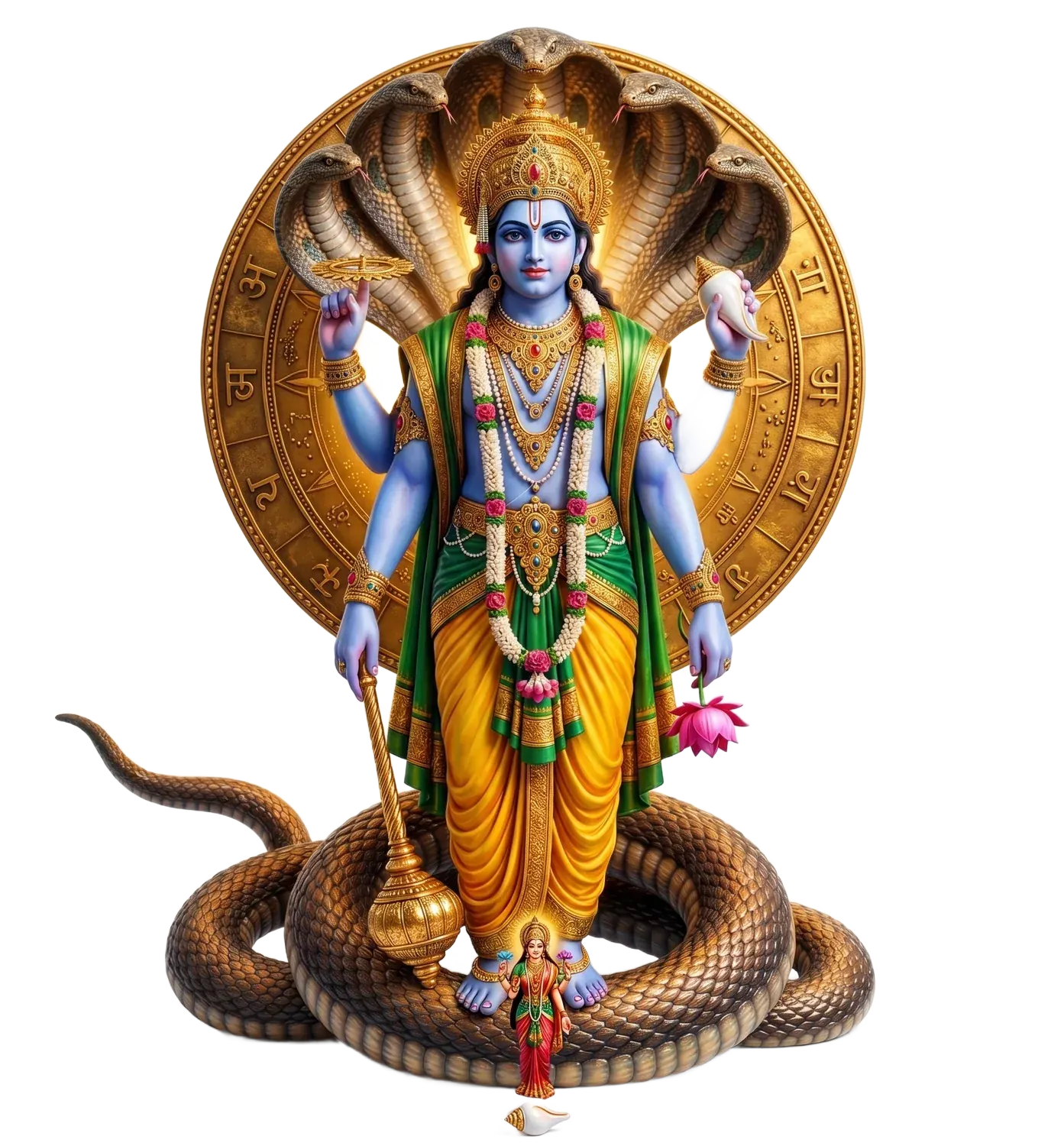
In a birth chart, all seven classical planets (Sun, Moon, Mars, Mercury, Jupiter, Venus and Saturn) are placed among the twelve houses, along with the two shadow points Rahu and Ketu, which always sit exactly opposite each other. Kaal Sarp Dosh is said to form when all seven of these planets fall on one side of the Rahu-Ketu axis, meaning they are all hemmed in between Rahu and Ketu with none crossing to the other side. The name comes from Kaal, meaning time or death, and Sarp, meaning serpent, since Rahu is symbolically visualised as a serpent's head and Ketu as its tail, with the planets caught as if within the coils of a great serpent.
What Kaal Sarp Dosh Means in Tradition
It is important to understand that Kaal Sarp Dosh is not a punishment and does not doom a person to a difficult life. In our tradition, Rahu and Ketu are understood as karmic indicators connected to past life patterns, unconventional paths, sudden events, and deep transformation. Classical texts describe this placement as one that can bring a sense of struggle, delays, or obstacles, particularly in the earlier parts of life, but they equally describe it as a configuration strongly associated with extraordinary achievement, spiritual depth, resilience and unconventional success once the person learns to work with its intensity rather than against it. Many highly accomplished and spiritually evolved individuals have been noted by astrologers to carry a Kaal Sarp yog in their charts.
The 12 Types of Kaal Sarp Dosh
The type of Kaal Sarp Dosh is determined by which house Rahu occupies, since this decides which axis all seven planets are enclosed within. Each type carries a distinct character and traditionally influences a different area of life.
1. Anant Kaal Sarp Dosh (Rahu in 1st house, Ketu in 7th): Associated with challenges related to self-confidence, health and identity, along with delays in marriage or partnerships.
2. Kulik Kaal Sarp Dosh (Rahu in 2nd, Ketu in 8th): Associated with financial fluctuations, family matters and speech-related concerns.
3. Vasuki Kaal Sarp Dosh (Rahu in 3rd, Ketu in 9th): Associated with relationships with siblings, courage, and matters related to fortune and higher learning.
4. Shankhpal Kaal Sarp Dosh (Rahu in 4th, Ketu in 10th): Associated with domestic peace, property, mother's wellbeing, and career direction.
5. Padma Kaal Sarp Dosh (Rahu in 5th, Ketu in 11th): Associated with education, children, creativity and gains or income.
6. Mahapadma Kaal Sarp Dosh (Rahu in 6th, Ketu in 12th): Associated with health, debts, rivals, and matters of loss or foreign connections.
7. Takshak Kaal Sarp Dosh (Rahu in 7th, Ketu in 1st): Associated with marriage, business partnerships and self-related matters.
8. Karkotak Kaal Sarp Dosh (Rahu in 8th, Ketu in 2nd): Associated with sudden events, transformation, family wealth and speech.
9. Shankhchur Kaal Sarp Dosh (Rahu in 9th, Ketu in 3rd): Associated with fortune, father's wellbeing, dharma, and courage or communication.
10. Ghatak Kaal Sarp Dosh (Rahu in 10th, Ketu in 4th): Associated with career, public reputation, home life and mother's wellbeing.
11. Vishdhar Kaal Sarp Dosh (Rahu in 11th, Ketu in 5th): Associated with income, social circle, children and creative pursuits.
12. Sheshnag Kaal Sarp Dosh (Rahu in 12th, Ketu in 6th): Associated with expenses, foreign matters, health, debts and hidden obstacles.
Each of these twelve configurations is traditionally read alongside the overall strength of the chart, the dasha period running, and aspects on Rahu and Ketu, so the exact real world experience differs greatly from person to person.
Common Symptoms Traditionally Linked to Kaal Sarp Dosh
People are sometimes told to look for repeated delays in major life milestones such as marriage, career or property matters, a recurring feeling of being held back despite effort, vivid or disturbing dreams involving snakes, and unexplained anxiety. These are traditional associations, not universal or guaranteed symptoms, and a proper kundali reading by a knowledgeable astrologer is the only reliable way to confirm whether this yog is genuinely present and how strongly it is affecting the chart.
Remedies for Kaal Sarp Dosh
1. Nag Panchami Puja: Worshipping Nag Devta on Nag Panchami with milk, and offering prayers at a Naga temple, is among the most recommended traditional remedies.
2. Rahu-Ketu Shanti Puja: A dedicated puja invoking Rahu and Ketu, performed with proper sankalp and mantra jaap, especially at sacred sites like Trimbakeshwar or Ujjain, is a well known and widely performed remedy.
3. Chant the Maha Mrityunjaya Mantra: This mantra, dedicated to Lord Shiva, is considered highly protective and is often recommended for those with Kaal Sarp Dosh, chanted 108 times daily.
4. Recite Rahu and Ketu Beej Mantras: Om Bhram Bhreem Bhroum Sah Rahave Namah for Rahu, and Om Sraam Sreem Sroum Sah Ketave Namah for Ketu, chanted with devotion, particularly on Saturdays.
5. Worship Lord Shiva Regularly: Since Shiva is believed to hold the power to calm serpent energies (he is often depicted wearing a serpent), regular Shiva puja, offering Bel patra and water on a Shivlinga, is considered deeply beneficial.
6. Silver Naga-Nagin Daan: Offering a pair of silver serpent idols in a flowing river, a well known traditional remedy, is believed to bring relief.
7. Keep a Kaal Sarp Yantra: Many households keep a properly energised Kaal Sarp Dosh Nivaran Yantra as a source of protection and steadiness.
8. Serve and Feed the Needy: Charitable acts, particularly feeding the poor or donating on Saturdays and during Rahu Kaal, are considered spiritually significant.
9. Practice Patience and Perseverance: Since this yog is deeply tied to karmic timing, our tradition emphasises that patience, right action and continued sincere effort, rather than shortcuts, ultimately allow its powerful energy to express itself positively.
A Gentle Reminder
Kaal Sarp Dosh should never be approached with fear. Its presence in a chart does not guarantee hardship, and many individuals with this yog go on to achieve extraordinary things once they learn to channel its intensity constructively. These remedies are offered as a matter of faith and tradition, meant to bring peace of mind, protection and steady progress, they are not deterministic predictions of doom and are not a substitute for professional medical, legal or financial advice where needed.
Frequently Asked Questions
Is Kaal Sarp Dosh always harmful? No. Its real effect depends on the overall strength of the chart, the specific type, and the running dasha. Many accomplished individuals carry this yog.
How can I know which of the 12 types I have? This depends on which house Rahu occupies in your birth chart, best confirmed through a personalised kundali reading.
Where is Rahu-Ketu Shanti Puja traditionally performed? Trimbakeshwar in Maharashtra and Ujjain in Madhya Pradesh are especially well known and widely visited sites for this puja, though it can be performed at any qualified temple with a knowledgeable pandit.
Does Kaal Sarp Dosh affect marriage timing? Some types, especially where Rahu or Ketu fall in the 7th house, are traditionally linked to delays in marriage, but this varies greatly by individual chart and is not a fixed rule.
Quick guide
Before you begin
Mantra
Devi mantra
Om Dum Durgaye Namah
Chant 11, 21, or 108 times according to your time and capacity.
Bhav
Benefits devotees pray for
FAQ
Common questions
Is Kaal Sarp Dosh always harmful?
No, its real effect depends on the chart's overall strength, the specific type, and running dasha. Many accomplished individuals carry this yog.
How can I know which of the 12 types I have?
This depends on which house Rahu occupies in your birth chart, best confirmed through a personalised kundali reading.
Where is Rahu-Ketu Shanti Puja traditionally performed?
Trimbakeshwar and Ujjain are especially well known sites, though it can be performed at any qualified temple with a knowledgeable pandit.
Does Kaal Sarp Dosh affect marriage timing?
Some types, especially with Rahu or Ketu in the 7th house, are traditionally linked to delays in marriage, but this varies by chart.
Book a Rahu-Ketu Shanti Puja
Find peace and protection with a dedicated Kaal Sarp Dosh remedy puja performed with full vidhi and sankalp.