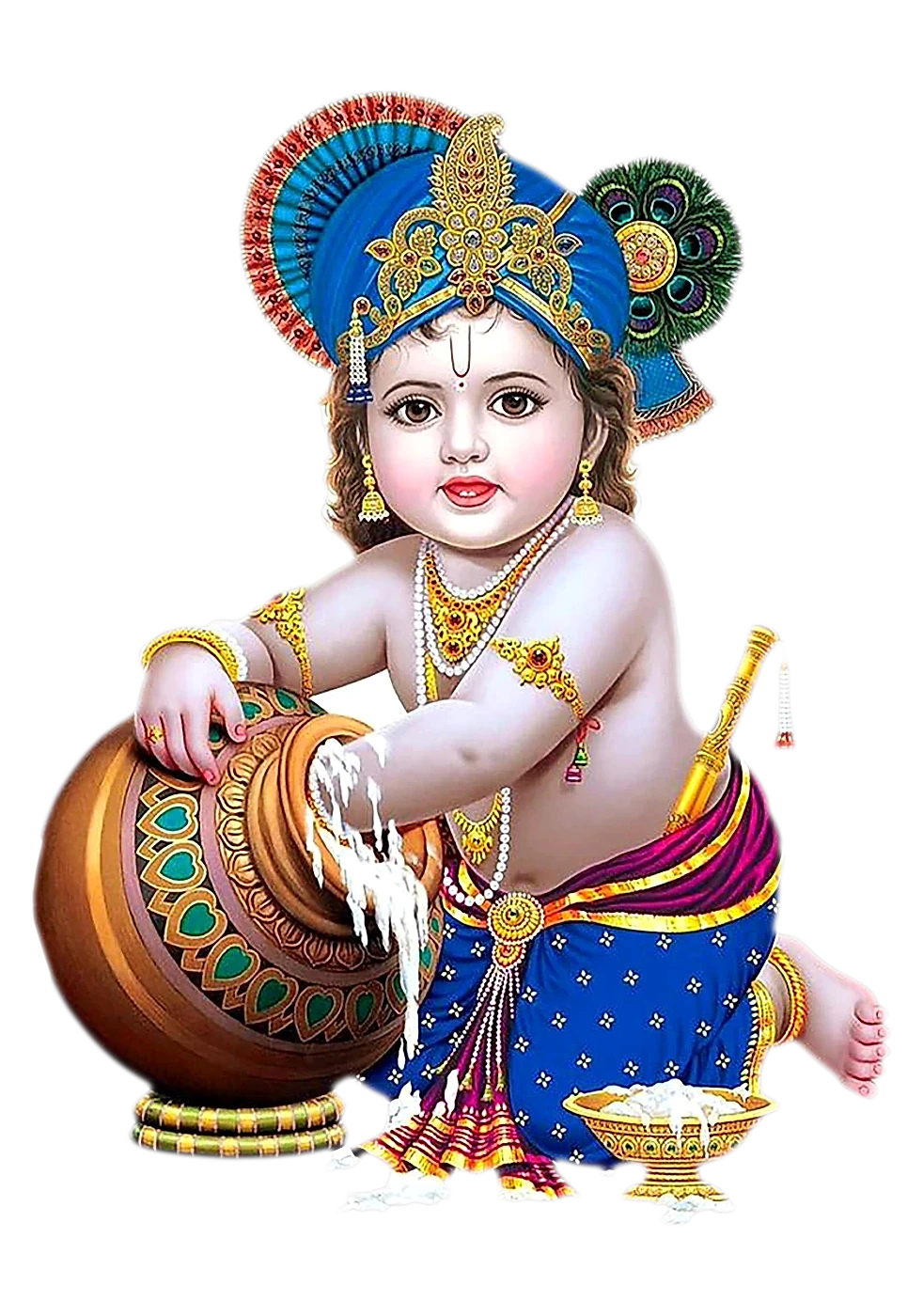


 यदा यदा हि धर्मस्य ग्लानिर्भवति भारत
Discover the complete Janmashtami vrat katha describing Lord Krishna's divine birth in Mathura's prison, along with the full puja vidhi observed at midnight.
Janmashtami celebrates the divine birth of Lord Krishna, the eighth avatar of Lord Vishnu, who descended on earth to restore dharma and vanquish evil. It is observed with great devotion on the Ashtami tithi of Krishna Paksha in the month of Bhadrapada, with fasting during the day and midnight worship marking the exact moment of his birth.
The Vrat Katha of Janmashtami
In the ancient city of Mathura, there ruled a cruel and tyrannical king named Kansa, who imprisoned his own father to seize the throne. Kansa had a beloved sister, Devaki, whom he dearly loved, and when she was married to Vasudev, Kansa himself drove the chariot to escort the newlywed couple with great affection.
But as they travelled, a divine voice from the sky declared that the eighth child born to Devaki would become the cause of Kansa's death. Terrified and enraged, Kansa immediately drew his sword to kill his own sister on the spot, but Vasudev pleaded for mercy, promising to hand over every child born to them, so that Kansa could do as he wished. Kansa relented but imprisoned both Devaki and Vasudev in a dark dungeon, and one by one, as each child was born, Kansa cruelly killed them, unable to escape the fear of the prophecy.
When the seventh pregnancy came, by divine will the child, who was an incarnation of Sheshnag, was mystically transferred to the womb of Rohini, Vasudev's other wife, and was born as Balarama, safe from Kansa's wrath.
Then came the eighth pregnancy. On the eighth day of the dark fortnight of Bhadrapada, at the stroke of midnight, amid thunder and lightning, Lord Vishnu himself was born to Devaki within the prison walls, as the divine child Krishna, appearing first in his four-armed cosmic form and then, at Vasudev's prayer, taking the form of a beautiful infant.
At this very moment, a divine voice instructed Vasudev to carry the newborn child across the river Yamuna to Gokul and exchange him with the daughter just born to Yashoda and Nanda, so that Krishna would be safe from Kansa. Miraculously, the prison chains fell away on their own, the guards fell into a deep magical sleep, and the doors opened by themselves. As Vasudev carried baby Krishna in a basket through the stormy night, the swollen Yamuna river parted its waters to let him pass, and the great serpent Sheshnag rose to shield the infant from the pouring rain.
Vasudev safely exchanged the children in Gokul and returned to the prison before dawn, placing the baby girl in Devaki's arms. When Kansa learned of the eighth child's birth, he rushed to kill her, but as he lifted her, she transformed into the goddess Yogmaya and rose into the sky, declaring that his real enemy, Krishna, was already safe and would return one day to end his tyranny.
Krishna grew up in Gokul and Vrindavan under the loving care of Nanda and Yashoda, delighting everyone with his divine leelas, protecting the villagers from numerous demons sent by Kansa, and eventually returning to Mathura years later to fulfill the prophecy, defeating Kansa and freeing his true parents, Devaki and Vasudev, restoring righteousness to the kingdom.
Janmashtami Puja Vidhi
Fasting: Devotees observe a strict fast, some consuming only fruits and milk, others observing a complete waterless fast (nirjala), from sunrise until midnight, when the fast is broken after Krishna's birth is celebrated.
Samagri needed: an idol of infant Krishna (Laddu Gopal), a small cradle (jhula), a copper kalash, panchamrit (milk, curd, ghee, honey, sugar), tulsi leaves, flowers, a peacock feather, makhan-mishri (butter and sugar), fruits, sandalwood paste, incense and a diya.
Step by step vidhi:
Clean the puja area and set up the idol of Bal Gopal in a decorated cradle, adorned with new clothes, a crown and a peacock feather.
Throughout the day, devotees may read or listen to stories from Krishna's life and chant his names.
As midnight approaches, gather the family near the cradle in anticipation of the birth moment.
At the exact stroke of midnight, bathe the idol with panchamrit, followed by clean water, symbolizing the sacred abhishek of the newborn Lord.
Dress the idol in fresh clothes, adorn with jewellery, tilak, tulsi leaves and a garland of flowers.
Offer makhan-mishri, fruits and sweets as bhog, along with incense and a lit diya.
Gently rock the cradle while singing devotional songs and chanting Om Namo Bhagavate Vasudevaya or Krishna's names.
Perform the aarti with the whole family, ring bells, and blow the conch to announce the divine birth.
Distribute the panchamrit and prasad among family and neighbours, and break the day's fast with this sacred offering.
Significance and Benefits
Janmashtami is a celebration of divine intervention, faith and the assurance that whenever dharma declines, the divine takes birth to restore balance and protect the righteous. It teaches devotees courage, surrender, and unwavering faith even in the darkest of circumstances, just as Vasudev and Devaki trusted in the divine plan despite years of suffering.
This vrat and its rituals are matters of tradition and devotion; those with health conditions should consult a doctor before undertaking a strict or waterless fast.
Quick guide
Before you begin
Mantra
Krishna mantra
Om Kleem Krishnaya Namah
Chant with love and surrender, especially before Krishna katha, aarti, or bhog.
Bhav
Benefits devotees pray for
FAQ
Common questions
Why is Janmashtami celebrated at midnight?
Lord Krishna was born at the exact stroke of midnight, so devotees keep a fast until that moment and perform the birth celebration and abhishek precisely then.
What is the significance of panchamrit abhishek?
Bathing the idol of infant Krishna with panchamrit symbolizes the sacred welcome given to the newborn Lord and is believed to bring purity and blessings to the home.
Can Janmashtami vrat be observed without a waterless fast?
Yes, many devotees observe a fruit-and-milk fast instead of a strict nirjala fast; the vrat can be adapted according to one's health and capacity.
What is the story behind Krishna being taken to Gokul?
A divine voice instructed Vasudev to carry newborn Krishna across the Yamuna to Gokul and exchange him with Yashoda's daughter, protecting him from Kansa, and the river and serpent Sheshnag miraculously aided the journey.
Celebrate Janmashtami with a Sacred Krishna Puja
Book a dedicated Krishna Puja performed by expert pandits and invite the blessings of dharma, protection and joy into your home this Janmashtami.