
 Bhagavad Gita · Chapter 5
What Chapter 5 teaches
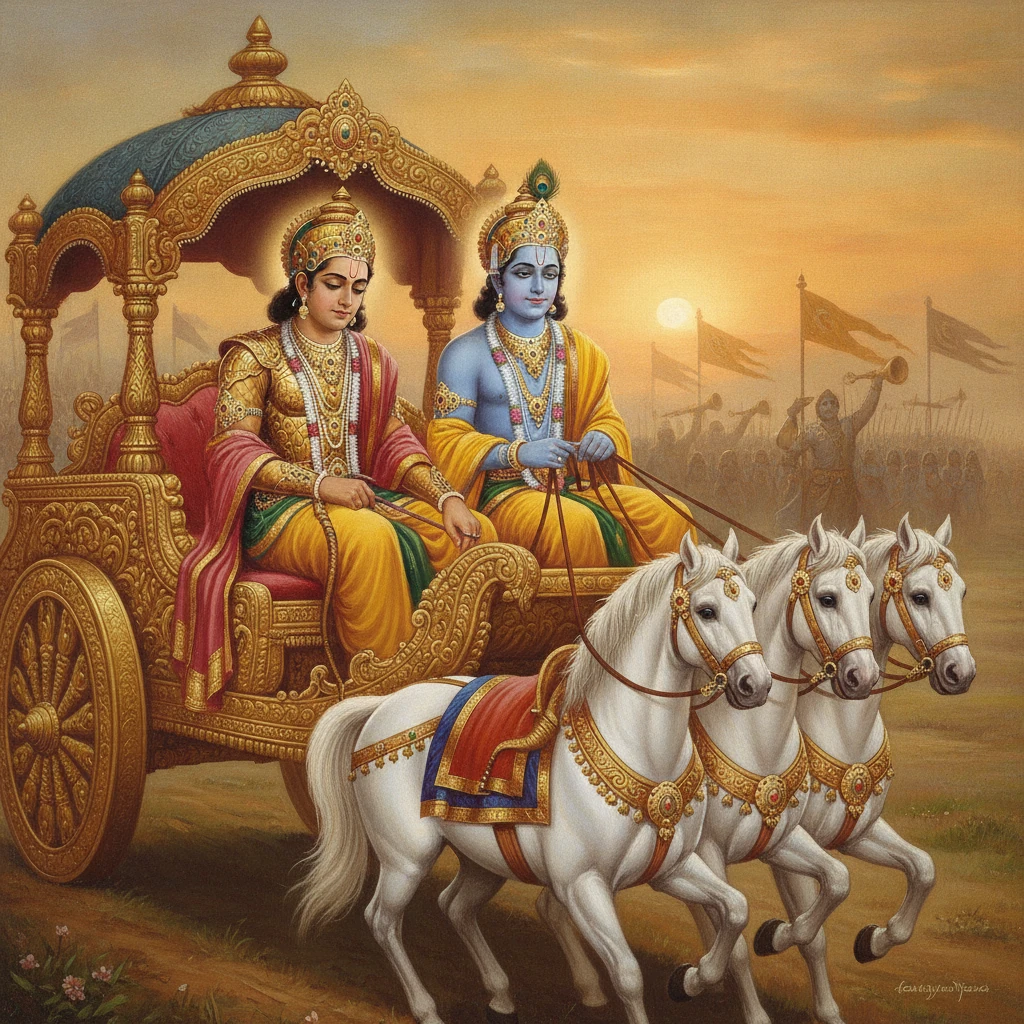
The fifth chapter of the Bhagavad Gita is Karma Sanyasa Yoga. In this chapter, Krishna compares the paths of renunciation in actions (Karma Sanyas) and actions with detachment (Karma Yoga) and explains that both are means to reach the same goal and we can choose either. A wise person should perform his/her worldly duties without attachment to the fruits of his/her actions and dedicate them to God. This way they remain unaffected by sin and eventually attain liberation.
Original Text
Verses & Meaning
अर्जुन उवाच। संन्यासं कर्मणां कृष्ण पुनर्योगं च शंससि। यच्छ्रेय एतयोरेकं तन्मे ब्रूहि सुनिश्चितम्॥
arjuna uvāca saṃnyāsaṃ karmaṇāṃ kṛṣṇa punaryogaṃ ca śaṃsasi yacchreya etayorekaṃ tanme brūhi suniścitam
Arjuna said Renunciation of actions, O Krishna, Thou praisest, and again Yoga. Tell me conclusively that which is the better of the two.
श्रीभगवानुवाच। संन्यासः कर्मयोगश्च निःश्रेयसकरावुभौ। तयोस्तु कर्मसंन्यासात्कर्मयोगो विशिष्यते॥
śrībhagavānuvāca saṃnyāsaḥ karmayogaśca niḥśreyasakarāvubhau tayostu karmasaṃnyāsātkarmayogo viśiṣyate
The Blessed Lord said Renunciation and the Yoga of action both lead to the highest bliss; but of the two, the Yoga of action is superior to the renunciation of action.
ज्ञेयः स नित्यसंन्यासी यो न द्वेष्टि न काङ्क्षति। निर्द्वन्द्वो हि महाबाहो सुखं बन्धात्प्रमुच्यते॥
jñeyaḥ sa nityasaṃnyāsī yo na dveṣṭi na kāṅkṣati nirdvandvo hi mahābāho sukhaṃ bandhātpramucyate
He should be known as a perpertual Sannyasi who neither hates nor desires; for, free from the pairs of opposites, O mighty-armed Arjuna, he is easily set free from bondage.
साङ्ख्ययोगौ पृथग्बालाः प्रवदन्ति न पण्डिताः। एकमप्यास्थितः सम्यगुभयोर्विन्दते फलम्॥
sāṅkhyayogau pṛthagbālāḥ pravadanti na paṇḍitāḥ ekamapyāsthitaḥ samyagubhayorvindate phalam
Children, not the wise, speak of knowledge and the Yoga of action or the performance of action as though they are distinct and different; he who is truly established in one obtains the fruits of both.
यत्साङ्ख्यैः प्राप्यते स्थानं तद्योगैरपि गम्यते। एकं साङ्ख्यं च योगं च यः पश्यति स पश्यति॥
yatsāṅkhyaiḥ prāpyate sthānaṃ tadyogairapi gamyate ekaṃ sāṅkhyaṃ ca yogaṃ ca yaḥ paśyati sa paśyati
That place which is reached by the Sankhyas or the Jnanis is reached by the Yogis (Karma Yogis). He sees, who sees knowledge and the performance of action (Karma Yoga) as one.
संन्यासस्तु महाबाहो दुःखमाप्तुमयोगतः। योगयुक्तो मुनिर्ब्रह्म नचिरेणाधिगच्छति॥
saṃnyāsastu mahābāho duḥkhamāptumayogataḥ yogayukto munirbrahma nacireṇādhigacchati
But renunciation, O mighty-armed Arjuna, is hard to attain without Yoga; the Yoga-harmonised sage ickly goes to Brahman.
योगयुक्तो विशुद्धात्मा विजितात्मा जितेन्द्रियः। सर्वभूतात्मभूतात्मा कुर्वन्नपि न लिप्यते॥
yogayukto viśuddhātmā vijitātmā jitendriyaḥ sarvabhūtātmabhūtātmā kurvannapi na lipyate
He who is devoted to the path of action, whose mind is ite pure, who has conered the self, who has subdued his senses and who realises his Self as the Self in all beings, though acting, is not tainted.
नैव किञ्चित्करोमीति युक्तो मन्येत तत्त्ववित्। पश्यञ्शृण्वन्स्पृशञ्जिघ्रन्नश्नन्गच्छन्स्वपञ्श्वसन्॥
naiva kiñcitkaromīti yukto manyeta tattvavit paśyañśruṇvanspṛśañjighrannaśnangacchansvapañśvasan
"I do nothing at all," thus would the harmonised knower of Truth think seeing, hearing, touching, smelling, eating, going, sleeping, breathing.
प्रलपन्विसृजन्गृह्णन्नुन्मिषन्निमिषन्नपि। इन्द्रियाणीन्द्रियार्थेषु वर्तन्त इति धारयन्॥
pralapanvisṛjangṛhṇannunmiṣannimiṣannapi indriyāṇīndriyārtheṣu vartanta iti dhārayan
Speaking, letting go, seizing, opening and closing the eyes convinced that the senses move among the sense-objects.
ब्रह्मण्याधाय कर्माणि सङ्गं त्यक्त्वा करोति यः। लिप्यते न स पापेन पद्मपत्रमिवाम्भसा॥
brahmaṇyādhāya karmāṇi saṅgaṃ tyaktvā karoti yaḥ lipyate na sa pāpena padmapatramivāmbhasā
He who does actions, offering them to Brahman, and abandoning attachment, is not tainted by sin, just as a lotus-leaf is not tainted by water.
कायेन मनसा बुद्ध्या केवलैरिन्द्रियैरपि। योगिनः कर्म कुर्वन्ति सङ्गं त्यक्त्वात्मशुद्धये॥
kāyena manasā buddhyā kevalairindriyairapi yoginaḥ karma kurvanti saṅgaṃ tyaktvātmaśuddhaye
Yogis, having abandoned attachment, perform actions only by the body, mind, intellect, and even by the senses, for the purification of the self.
युक्तः कर्मफलं त्यक्त्वा शान्तिमाप्नोति नैष्ठिकीम्। अयुक्तः कामकारेण फले सक्तो निबध्यते॥
yuktaḥ karmaphalaṃ tyaktvā śāntimāpnoti naiṣṭhikīm ayuktaḥ kāmakāreṇa phale sakto nibadhyate
The united one (the well poised or the harmonised) having abandoned the fruit of action attains to the eternal peace: the non-united only (the unsteady or the unbalanced) impelled by desire, attached to the fruit, is bound.
सर्वकर्माणि मनसा संन्यस्यास्ते सुखं वशी। नवद्वारे पुरे देही नैव कुर्वन्न कारयन्॥
sarvakarmāṇi manasā saṃnyasyāste sukhaṃ vaśī navadvāre pure dehī naiva kurvanna kārayan
Mentally renouncing all actions and self-controlled, the embodied one rests happily in the nine-gated city, neither acting nor causing others (body and senses) to act.
न कर्तृत्वं न कर्माणि लोकस्य सृजति प्रभुः। न कर्मफलसंयोगं स्वभावस्तु प्रवर्तते॥
na kartṛtvaṃ na karmāṇi lokasya sṛjati prabhuḥ na karmaphalasaṃyogaṃ svabhāvastu pravartate
Neither agency nor actions does the Lord create for the world, nor union with the fruits of actions. But it is Nature that acts.
नादत्ते कस्यचित्पापं न चैव सुकृतं विभुः। अज्ञानेनावृतं ज्ञानं तेन मुह्यन्ति जन्तवः॥
nādatte kasyacitpāpaṃ na caiva sukṛtaṃ vibhuḥ ajñānenāvṛtaṃ jñānaṃ tena muhyanti jantavaḥ
The Lord takes neither the demerit nor even the merit of any; knowledge is enveloped by ignorance, thery beings are deluded.
ज्ञानेन तु तदज्ञानं येषां नाशितमात्मनः। तेषामादित्यवज्ज्ञानं प्रकाशयति तत्परम्॥
jñānena tu tadajñānaṃ yeṣāṃ nāśitamātmanaḥ teṣāmādityavajjñānaṃ prakāśayati tatparam
But to those whose ignorance is destroyed by the knowledge of the Self, like the sun, knowledge reveals the Supreme (Brahman).
तद्बुद्धयस्तदात्मानस्तन्निष्ठास्तत्परायणाः। गच्छन्त्यपुनरावृत्तिं ज्ञाननिर्धूतकल्मषाः॥
tadbuddhayastadātmānastanniṣṭhāstatparāyaṇāḥ gacchantyapunarāvṛttiṃ jñānanirdhūtakalmaṣāḥ
Their intellect absorbed in That, their self being That, established in That, with That for their supreme goal, they go whence there is no return, their sins dispelled by knowledge.
विद्याविनयसम्पन्ने ब्राह्मणे गवि हस्तिनि। शुनि चैव श्वपाके च पण्डिताः समदर्शिनः॥
vidyāvinayasampanne brāhmaṇe gavi hastini śuni caiva śvapāke ca paṇḍitāḥ samadarśinaḥ
Sages look with an eal eye on a Brahmana endowed with learning and humility, on a cow, on an elephant, and even on a dog and an outcaste.
इहैव तैर्जितः सर्गो येषां साम्ये स्थितं मनः। निर्दोषं हि समं ब्रह्म तस्माद् ब्रह्मणि ते स्थिताः॥
ihaiva tairjitaḥ sargo yeṣāṃ sāmye sthitaṃ manaḥ nirdoṣaṃ hi samaṃ brahma tasmād brahmaṇi te sthitāḥ
Even here (in this world) birth (everything) is overcome by those whose minds rest in eality; Brahman is spotless indeed and eal; therefore they are established in Brahman.
न प्रहृष्येत्प्रियं प्राप्य नोद्विजेत्प्राप्य चाप्रियम्। स्थिरबुद्धिरसम्मूढो ब्रह्मविद् ब्रह्मणि स्थितः॥
na prahṛṣyetpriyaṃ prāpya nodvijetprāpya cāpriyam sthirabuddhirasammūḍho brahmavid brahmaṇi sthitaḥ
Resting in Brahman, with steady intellect and undeluded, the knower of Brahman neither rejoiceth on obtaining what is pleasant nor grieveth on obtaining what is unpleasant.
बाह्यस्पर्शेष्वसक्तात्मा विन्दत्यात्मनि यत्सुखम्। स ब्रह्मयोगयुक्तात्मा सुखमक्षयमश्नुते॥
bāhyasparśeṣvasaktātmā vindatyātmani yatsukham sa brahmayogayuktātmā sukhamakṣayamaśnute
With the self unattached to external contacts he finds happiness in the Self; with the self engaged in the meditation of Brahman he attains to the endless happiness.
ये हि संस्पर्शजा भोगा दुःखयोनय एव ते। आद्यन्तवन्तः कौन्तेय न तेषु रमते बुधः॥
ye hi saṃsparśajā bhogā duḥkhayonaya eva te ādyantavantaḥ kaunteya na teṣu ramate budhaḥ
The enjoyments that are born of contacts are only generators of pain, for they have a beginning and an end, O Arjuna; the wise man does not rejoice in them.
शक्नोतीहैव यः सोढुं प्राक्शरीरविमोक्षणात्। कामक्रोधोद्भवं वेगं स युक्तः स सुखी नरः॥
śaknotīhaiva yaḥ soḍhuṃ prākśarīravimokṣaṇāt kāmakrodhodbhavaṃ vegaṃ sa yuktaḥ sa sukhī naraḥ
He who is able, while still here (in this world) to withstand, before the liberation from the body, the impulse born out of desire and anger he is a Yogi, he is a happy man.
योऽन्तःसुखोऽन्तरारामस्तथान्तर्ज्योतिरेव यः। स योगी ब्रह्मनिर्वाणं ब्रह्मभूतोऽधिगच्छति॥
yo.antaḥsukho.antarārāmastathāntarjyotireva yaḥ sa yogī brahmanirvāṇaṃ brahmabhūto.adhigacchati
He who is happy within, who rejoices within, and who is illuminated within, that Yogi attains absolute freedom or Moksha, himself becoming Brahman.
लभन्ते ब्रह्मनिर्वाणमृषयः क्षीणकल्मषाः। छिन्नद्वैधा यतात्मानः सर्वभूतहिते रताः॥
labhante brahmanirvāṇamṛṣayaḥ kṣīṇakalmaṣāḥ chinnadvaidhā yatātmānaḥ sarvabhūtahite ratāḥ
The sages (Rishis) obtain absolute freedom or Moksha they whose sins have been destroyed, whose dualities (perception of dualities or experience of the pairs of opposites) are torn asunder, who are self-controlled, and intent on the welfare of all beings.
कामक्रोधवियुक्तानां यतीनां यतचेतसाम्। अभितो ब्रह्मनिर्वाणं वर्तते विदितात्मनाम्॥
kāmakrodhaviyuktānāṃ yatīnāṃ yatacetasām abhito brahmanirvāṇaṃ vartate viditātmanām
Absolute freedom (or Brahmic bliss) exists on all sides for those self-controlled ascetics who are free from desire and anger, who have controlled their thoughts and who have realised the Self.
स्पर्शान्कृत्वा बहिर्बाह्यांश्चक्षुश्चैवान्तरे भ्रुवोः। प्राणापानौ समौ कृत्वा नासाभ्यन्तरचारिणौ॥
sparśānkṛtvā bahirbāhyāṃścakṣuścaivāntare bhruvoḥ prāṇāpānau samau kṛtvā nāsābhyantaracāriṇau
Shutting out (all) external contacts and fixing the gaze between the eyrow, ealising the outgoing and incoming breaths moving within the nostrils.
यतेन्द्रियमनोबुद्धिर्मुनिर्मोक्षपरायणः। विगतेच्छाभयक्रोधो यः सदा मुक्त एव सः॥
yatendriyamanobuddhirmunirmokṣaparāyaṇaḥ vigatecchābhayakrodho yaḥ sadā mukta eva saḥ
With the senses, the mind and the intellect (ever) controlled, having liberation as his supreme goal, free from desire, fear and anger the sage is verily liberated for ever.
भोक्तारं यज्ञतपसां सर्वलोकमहेश्वरम्। सुहृदं सर्वभूतानां ज्ञात्वा मां शान्तिमृच्छति॥
bhoktāraṃ yajñatapasāṃ sarvalokamaheśvaram suhṛdaṃ sarvabhūtānāṃ jñātvā māṃ śāntimṛcchati
He who knows Me as the enjoyer of sacrifices and austerities, the great Lord of all the worlds and the friend of all beings, attains to peace.
Quick guide
Before you begin
Bhav
Benefits devotees pray for
FAQ
Common questions
What is Bhagavad Gita Chapter 5 (Karma Sanyasa Yoga) about?
The fifth chapter of the Bhagavad Gita is Karma Sanyasa Yoga. In this chapter, Krishna compares the paths of renunciation in actions (Karma Sanyas) and actions with detachment (Karma Yoga) and explains that both are means to reach the same goal and we can choose either. A wise person should perform his/her worldly duties without attachment to the fruits of his/her actions and dedicate them to God. This way they remain unaffected by sin and eventually attain liberation.
How many verses are in Bhagavad Gita Chapter 5?
Chapter 5 (Karma Sanyasa Yoga) has 29 verses. You can read every one above in Sanskrit, with IAST transliteration and its meaning in Hindi and English.
What does "Karma Sanyasa Yoga" mean?
"Karma Sanyasa Yoga" is the name of Chapter 5 of the Bhagavad Gita; it means "Path of Renunciation". Its 29 verses form part of Bhagwan Krishna's teaching to Arjuna on the field of Kurukshetra.
Bring the Gita's wisdom into your life
On Gita Jayanti at Shri Vishnupad Mandir, Gaya, a sankalp is offered in your naam-gotra for clarity of mind and right decision. Book the seva, or continue reading the Bhagavad Gita.